Christians in the Great War
Sunday August 2, 1914, second day of the mobilization. Loÿs Roux (32 years old) and his brother Joseph (33 years old), mobilized priests from Lyon, are cheered by young socialists who shake their hands: “We shouted ‘Down with the skullcap! Down with the three years (1)!’ Now we are all friends, all brothers! »
Like the poilus, the Redheads are determined: “We will do our duty, old man. I am a nurse. But if I can use the Lebel (rifle, Editor’s note), I won’t miss it,” confides Loÿs to a companion. He adds in his diary: “These people seem to have discovered the priest. They didn’t imagine him to be so patriotic or so simple. »
In a few vivid sentences, Loÿs Roux – whose Manuscripts Museum in Paris has highlighted the important testimony of a chaplain-nurse and war reporter-photographer (2) – summarizes the state of mind of French citizens at the dawn of the world conflict. “The sacred union which is formed to defend the homeland is not only political. It brings together lay people and believers of all religions,” explains Xavier Boniface, author of a Religious History of the Great War (3).
► Photo gallery. The photographic archives of the exhibition “Between the lines and the trenches”.
The support of the French clergy for the war and, to a certain extent, that of the parishioners, was not immediately acquired. From 1901, anti-congregational laws forcing tens of thousands of religious people to leave France, then, in 1905, the law separating Church and State, seemed to have divided the country between believers and non-believers. In 1914, anticlericalism was widespread in regions such as Provence and Limousin.
And yet, over the entire duration of the conflict, more than 23,000 priests and seminarians (mobilized since the law of 1889, known as “backpack priests”) but also 9,300 religious, responded to the call. In August 1914, the religious in exile returned, overtaking the Germans who were sweeping across northern France.
Surprised, the mayor of Arlon, in Belgium, greets those walking towards the border: “The Republic will no longer find that you are too much! » In fact, the army integrates them. A few are appointed chaplains, many become stretcher bearers or nurses, most are soldiers and unofficial chaplains…
For the Church, serving one’s homeland is serving God
“This patriotism is not so surprising,” says Xavier Boniface. The Church’s message has always been: to serve one’s homeland is to serve God. » Moreover, simple believers respond to the mobilization order. “We have overestimated the divide of 1905,” analyzes the historian. In reality, the majority of French Catholics have joined the Republic since 1892 on the advice of Leo XIII, undoubtedly even before. » The war then becomes an opportunity to prove one’s patriotism and to refute the accusation of serving first the pope.
In the summer of 1914, if the young socialists crossed by Loÿs Roux abandoned their pacifist ideas, so did the believers: “Germany being the aggressor, it is easy for the French clergy to justify their commitment according to the argument that this war is just,” continues Xavier Boniface. Which does not prevent German Christians, Catholics or Protestants, from also thinking that God is on their side (“Gott mit uns”)! »
Father Loÿs admits that it has been ten years since he resolved to fight this war and that he reproaches the inhabitants of Beaujolais for their lack of commitment: “We think of ourselves, but little of France. » Which does not prevent him from concluding: “Oh how sad these departures are. We will do our duty, but may the Good Lord spare us. Not us, priests, but the fathers of families. »
Joseph and Loÿs Roux, two hairy priests, here, at La Fontenelle, in the Vosges, June 21, 1915. © coll. private – Museum of Letters and Manuscripts – Paris
No need for a confessional, a corner of land is enough
In fact, the Roux brothers demonstrate a dedication that they consider evident: “If we, the priests, require the faithful to do their duty, should we not, from time to time, give them the example of heroism or else what is the point of mass and communion every morning? » writes Loÿs.
Engaged in the same infantry regiment, the 23rd RI, very exposed throughout the war, they refused any promotion and put themselves at the service of their comrades: “Like many priests, they carry out chores of all kinds and, above all, take care of picking up the wounded, consoling the dying, temporarily burying then exhuming the dead, writing to the families…” says Jean-Pierre Guéno, curator of the exhibition where the photos of life daily life of the soldiers, taken by the two brothers, are highlighted.
Jean-François Petit, Assumptionist religious, studied The Great War a review from La Bonne Presse which appeared every month between 1915 and 1917. Fueled by letters from Catholic readers, it showed in snapshots “the enormous changes in religious practices that the war imposed. Questions are debated: do we have the right to say mass in a wagon? Can nuns abandon the fence to welcome and care for soldiers? »
Concretely, Rome answers yes, then the clergy innovates on its own as emergencies arise: homilies become shorter and simpler, collective absolutions are given before the assault, suitcases with portable altars and miniaturized objects of worship multiply…
Joseph Roux recounts it in a letter dated June 15, 1915 (he was killed by a shell on the Champagne front in December): “To confess, we walk on a road, in a field and we give absolution discreetly; no need for a confessional, a small corner of Vosges land is enough. »
Soldiers gathered for a mass in the Soissonnais quarries. © First World War / NBL Collection / Kharbine Tapabor
Pastoral life becomes simpler
“At the back also,” explains Jean-François Petit, “practices are changing: the laity must take more responsibility in the face of the shortage of priests. Some become “celebration presidents”, the lady patronesses take care of war orphans… The children themselves are enlisted in pious participation in the war effort, like these little girls who sew altar linen, because 15,000 nuns are called to become nurses. »
This simplification of pastoral life and this more direct relationship with the world reinforce the convictions of the French Catholic Youth Action movement, founded at the end of the 19th century. For Jean-François Petit: “It is the place of a new form of Christian life based on an ideal of solidarity, fraternity and equality in the face of trial which will permeate the entire 20th century and lead to the reforms of Vatican II. »
No masses in purgatory
For Xavier Boniface the ferments were already present before the war: “1914-1918 accelerated this movement. In the trenches, the priests were confronted with young men, those who went to mass the least. » At the same time, the nascent interreligious dialogue is nourished by war relations such as, for example, the friendship established between Pastor Nick and Cardinal Liénart.
Popular religiosity is strengthened in the face of the ever-present danger of death, such as the habit of wearing a protective medallion. At the rear, this is also reflected in the success of pilgrimages, devotions to the Virgin, to Joan of Arc, to Thérèse of Lisieux… But the letters from the priests confirm that – except at the very beginning of the war and except for masses in memory of their deceased comrades – the practice was not stronger during the conflict than before the war. This is what Daniel Moulinet notes in the correspondence of 130 Bourbonnais priests and seminarians sent to the front (4). “As always when faced with an inhuman ordeal, there are some spectacular conversions and, conversely, others who move away from God, seeing in the horrors of war the proof of his non-existence,” says Jean-François Petit.
Few theological upheavals arise from the trial by fire. “These are rather spiritual questions which are changing,” explains Xavier Boniface. So, since hell seems to have descended to earth, there are fewer masses for souls in purgatory. And a trend is emerging, which the bishops are trying to resist: soldiers who die as heroes are martyrs who go directly to heaven. »
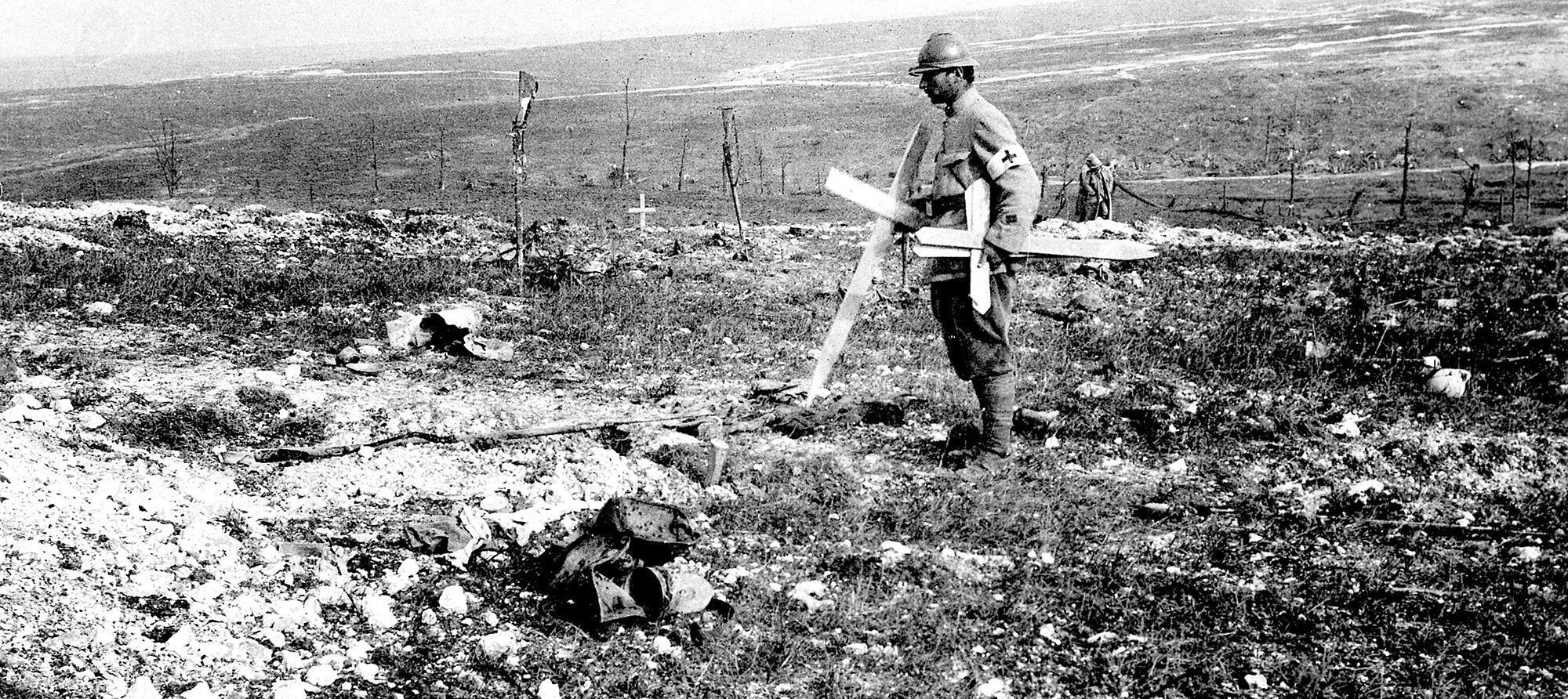
It is true that the propaganda, to which the Church adheres, heroizes these soldiers pulverized by artillery and demonizes the “Boche”. “But at the front, the priests, like all the soldiers, expressed little hatred towards this enemy that they knew,” also notes Xavier Boniface. Loÿs Roux, responsible like many priests, for identifying them, will not forget these moments when he planted the black crosses for the Germans, white for the French. Grief and weariness overcome him: “So many deaths! he said in September 1916. I am certainly used to corpses but in front of everyone I can’t help crying. It’s poignant. Oh ! War! »
In 1914, during the Battle of the Marne, a chaplain gave extreme unction to a dying soldier. © Coll. O. Calonge / adoc-photos / AW
The 4953 deaths of the clergy
As the conflict drags on, Catholic discourses seek meaning, evoking the “crusade”, the “bloody purification” for the nation’s faults. After the armistice, a whole class of priests but also lay Catholics will find themselves in veterans’ associations. “On the one hand, there will be the momentum of Catholic Action, on the other, some of these associations will, unfortunately, serve as breeding ground for the thinking of Vichy, of a France which must regenerate itself after the ordeal that God has sent it,” notes Jean-François Petit.
Anticlericalism has declined. However, from 1915, an “infamous rumor” again attempted to discredit the patriotism of priests. To refute it, Father Calixte Boulesteix, an Assumptionist, published in two volumes in 1925 The guestbook of the clergy and congregations, a sort of directory of all those involved, accompanied by a photo album. Henry Bordeaux, of the French Academy, in his introductory booklet The blood of priests, pays tribute to the 4,953 members of the clergy who died for France. In Lyon, Loÿs Roux regains his cassock and is photographed on the same bench as before the war. But Joseph is no longer sitting next to him.
(1) Law extending the duration of military service that the socialists denounced.
(2) “Between the lines and the trenches”, exhibition catalog Ed. Gallimard, by Jean-Yves Guéno and Gérard Lheureux, 188 p. ; €29.
(3) Ed. Fayard, 500 p. ; €26.
(4) Soldier priests in the Great War, Bourbonnais clerics under the flags, Ed. Rennes University Press, 332 p. ; €19.