
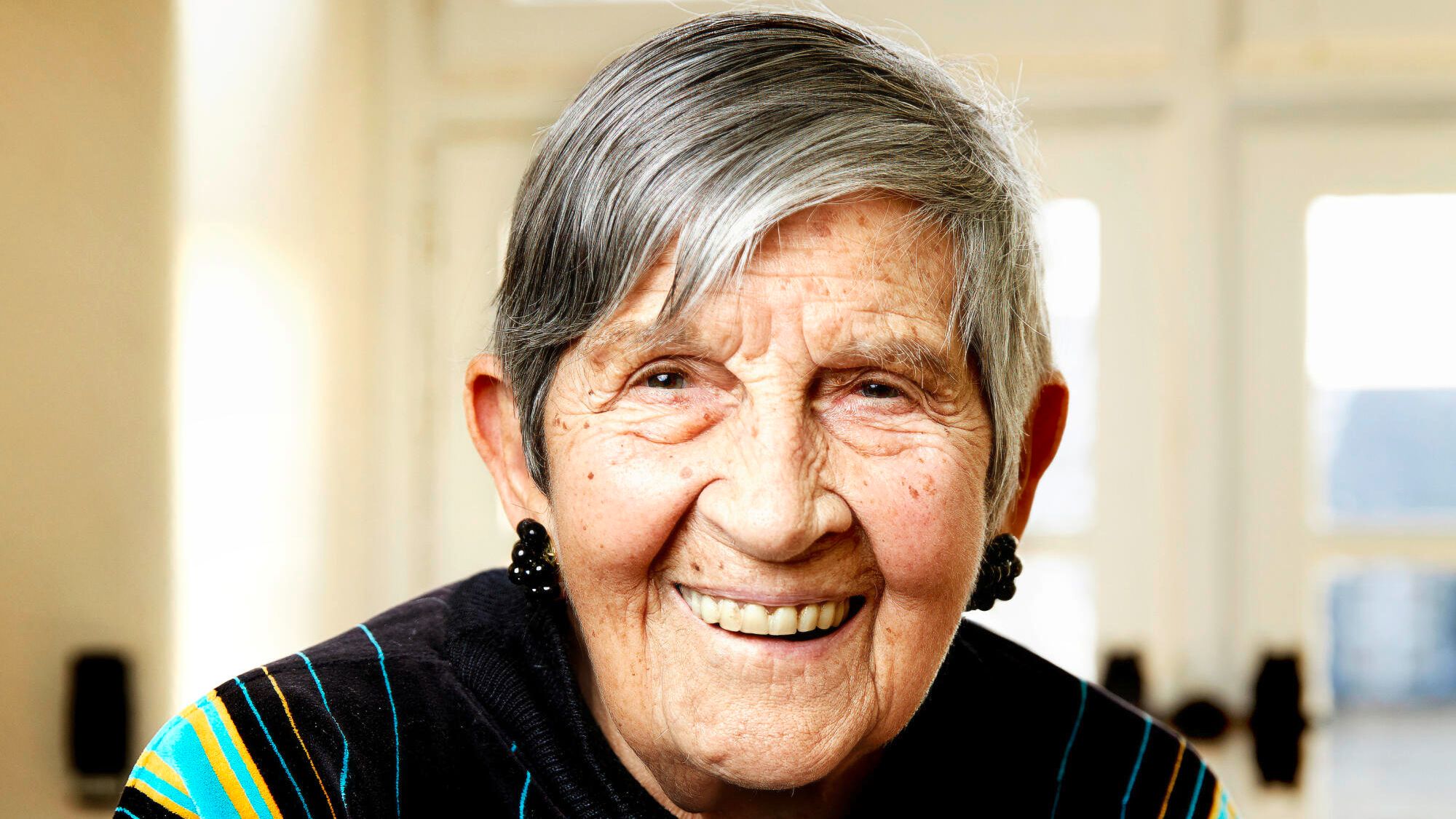
“I tell where hatred can lead”
On February 4, you will celebrate your 101st birthday. How are you ?
The 101 years, I’m not there yet… And if I don’t get there, it wouldn’t be very serious. I move more and more with difficulty, I see less and less. That’s how it is. I take things as they come.
But there are still joys and pleasures in life?
Yes, full! I have a united family: a son, two grandsons, four great-grandchildren. They are all fine. I have visits that delight me – like yours today. I sometimes wonder why I live so long, but I will still do nothing to shorten my days. All is not well in the world and in our country. Anti-Semitism and racism are regaining ground… But I tell myself that it has always existed. And that doesn’t stop me from finding that life is beautiful.
The 1st January, you were elevated to the rank of Commander of the Legion of Honor. How do you welcome this distinction?
It seems that to be decorated, someone must have asked for it. For my previous medals, I know that it was Simone Veil, whom I had known in prison in Drancy, in 1944, and who had remained a friend. For this one, I have no idea… I’m not asking for anything, and I very sincerely wonder if it’s deserved. Commander, do you realize? Today, I live in Les Invalides, I see people who have been in war, lost an arm or a leg… These medals are made for heroes. I’m not a heroine. I was lucky to survive, among others, that’s all.
On your room door it says “Ginette Cherkaski”…
I don’t know why the administration registered me under my maiden name, but I don’t care. Moreover, today, when you get married, you have the right to keep your birth surname, this is happening more and more. So why not? Cherkaski is a name that comes from Ukraine. My grandfather fled his country at the end of the 19th century, probably because of the pogroms. It was under this name that I was arrested on March 13, 1944, in Avignon, with my father, my little brother and my nephew, son of one of my five sisters who had already been deported a year earlier.
When you tell, you close your eyes…
Yes, I see things quite clearly. Prison in Marseille, then in Drancy, and departure for the Auschwitz-Birkenau camp in April. My father, who was 61 years old, and my little brother, aged 12, who got into the truck when they got off the train. I was happy, because I thought they would be less tired to reach the camp. In fact, I learned very quickly that they had gone straight to the gas chamber. These images are there forever, even if I don’t feel pain or pain when remembering them.
How do you explain it?
I don’t explain it, that’s how it is. In the camp, the Nazis made us machines, incapable of thinking, of feeling the slightest compassion. Even today, I have no feelings. I left them in Poland. I haven’t cried in eighty years.
Yet you say that life is beautiful. And in your new book , you say that you were happy with your husband, Albert Kolinka.
Yes, but that’s family. It’s quite a selfish happiness. It’s true that I loved my husband and we were happy. I married him in 1952. We went to markets in the Paris suburbs, in Pantin and Aubervilliers (Seine-Saint-Denis), where we sold hosiery: underwear, socks and various accessories. We loved this job, the contact with people, the jokes… and not having a boss too. For forty years we lived together twenty-four hours a day. It wasn’t until retirement that we started to drift apart a little: he liked to go to the gym by bus, and I preferred the metro. So we went our separate ways and found ourselves in the room. (laughs).
During this long life together, you never told your husband about your deportation…
No, I didn’t want to bother him with that. He was, of course, aware that I had been to Auschwitz, just as I knew that he had been a prisoner of war as a lumberjack in the forests of Germany. But we never talked about it.
For what ?
When I was young, I had a brother-in-law who, at every family meal, told us his regimental stories. As soon as he started, everyone rolled their eyes and murmured: “That’s it! Here he is again with his old refrains.” When I left the Theresienstadt camp, where I had been transferred after Auschwitz and Bergen-Belsen, the first thing I thought was: “I will never tell anyone what I experienced.”
And I kept my word for more than half a century. To one or two people who asked me the question after the war, I replied: “If it were to come back, and I had a child, I would rather strangle him with my own hands than let him suffer what I suffered.” I said that. Today, I find it ridiculous. I came back, I’m alive, and that’s good. You have to let luck do what it has to do.
“Even today I have no feelings. I left them in Poland”
Ginette Kolinka
Is that luck for you?
Yes, only. Some would like to suppose that we have qualities that would have helped us to hold on: courage, will, or whatever… But no! In the state we were in, there was neither courage nor will. I was like a robot, caught in an unchanging cycle, unable to think. When I was given a shovel, I cleared; a wheelbarrow, I carried the stones; a mass, I broke the stones. Our survival depended solely on the kapos (inmates responsible for commanding teams of fellow prisoners in the camp, editor’s note) who could hit us for no reason and kill us.
Today, you are a tireless witness. What led you to change your mind?
When my husband died, I approached an association, the Union of Auschwitz Deportees. One day, one of the managers, who had become a friend, asked me to replace one of the members of the association at short notice to accompany a group of young people to Poland. To do him a favor, I accepted. Since that day, I have returned there many times, and I have visited middle and high schools all over France. I continue today, but only in the Paris region. Except during school holidays when I’m unemployed and I’m bored!
What do you say to these young people?
When I start to speak, I close my eyes – as you noticed – and the memories come flooding back. So I tell them about my life. I show them where hatred can lead, by telling them very simply that if everything I experienced happened, it is because a man – you will tell me that Nazism is a system of course, but I say a man: Hitler – wanted to exterminate us, out of hatred. I want today’s children to accept that others live!
Are you ever surprised or taken aback by questions?
No. I answer all the questions, only saying what I experienced and what I remember, but without hiding anything from them. There are things I don’t remember. For example, I am unable to say the names or see the faces of the women I slept with for seven months. It must be said that we were head to tail, the neighbors’ feet in each other’s faces, and as soon as I climbed onto my “coya”, these wooden pallets where there were three of us per berth, I fell asleep like a pickaxe.
“Seeing young people of diverse origins living together gives me hope”
Ginette Kolinka
Do you feel like you are being listened to?
Sometimes teachers tell me: “If only my students could listen to me for twenty minutes like they just listened to you for two hours!” So I answer them: “It’s because I tell them interesting things!” All joking aside, I really like the young people I meet. I often go to classes where there are young people from very diverse origins, from all religions, who have lived together since kindergarten, accepting their differences. This gives me hope.
But I know things are not that simple. Sometimes I ask: “Who is racist or anti-Semitic in this class? Who knows racist people? Of course, no one! I still tell them: “Talk to your parents this evening. Tell them what you heard! Discuss. And then ask your grandparents! They may not know the latest singer, but they have plenty to teach you.” If two or three per class do it, that’s already good.
ITS ORGANIC
- February 4, 1925: Ginette Cherkaski was born in Paris, into an atheist Jewish family. She is the sixth daughter. A little brother, Gilbert, will be born later.
- 1942: his family fled Paris and took refuge in Avignon (Vaucluse).
- March 13, 1944: denounced, she is arrested by the Gestapo and deported to Auschwitz. She will be released in May 1945.
- 1952: marriage with Albert Kolinka (1913-1993).
- 1993: release of Schindler’s List, by Steven Spielberg. Ginette recounts her deportation for the first time as part of the Spielberg Foundation, created by the American director.
- Early 2000s: begins to testify in middle and high schools. “As long as I have the strength, I will continue.”