
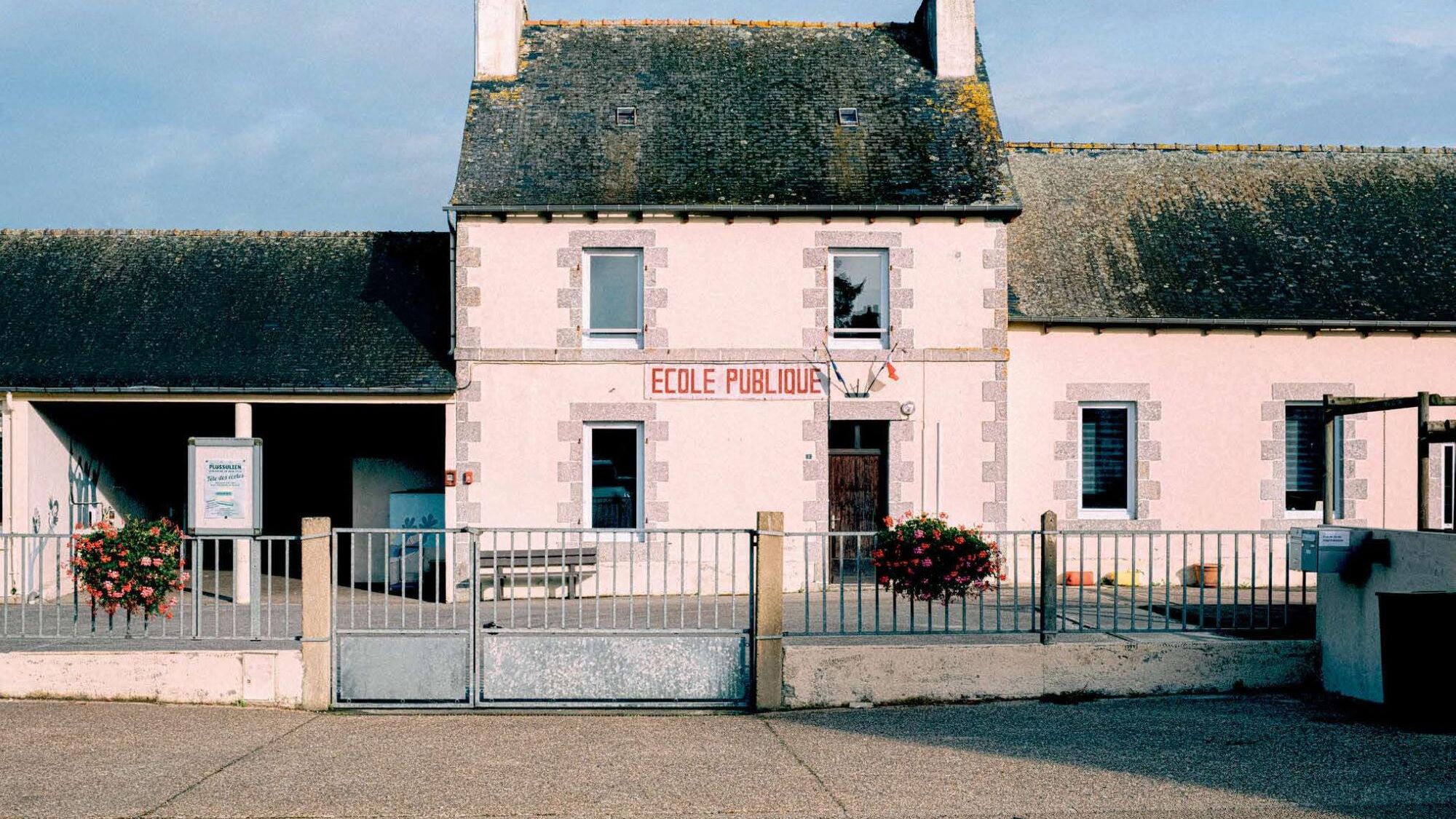
More by the Breton village fighting to keep his school
Himber scents escape from the bakery. The Bakery Green Bakery Curtain. It is 4 p.m., plusulian leaves the lunch break. In this town of Côtes-d’Armor, we live at the rhythm of school outings: as soon as the ringing sounds, the children and their parents fill the streets. As the countryside is emptying, this village of 500 inhabitants has kept two shops. Better still, between 2020 and 2024, the installation of families has rejuvenated and increased the population by around 7 % per year, according to the town hall census. A level much higher than the Breton average (+ 0.5 % per year according to INSEE) and an exception in the region. It must be said that since the 1990s, the town hall has been betting on the proximity of schools to attract parents.
But here it is: at the start of the 2024 school year, one of the two primary classes was removed, despite an inter-municipal educational group with Saint-Mayeux. Twenty-three students from CP to CM2 go to PlusSulien; 35 children, younger, in Saint-Mayeux. Generally, in rural areas, the rectorate closes a class if the total number of pupils of this grouping is less than 50. However, they are 58 by combining the two sites. But the administration has not counted the under 3, too young to appear in the tables.
When the cleaver fell, the inhabitants have become aware of the fragility of the demographic balance built over the years. As a sign of protest, the mayor even resigned. “A village where children are not heard screaming in the school courtyard becomes a dormitory village,” said with her imagined words Claudine Brossard, who succeeded him. In Plus, the buildings with raw stone walls patinated by centuries and spray, are not part of the decor. The buildings pushed in the 1970s, the agricultural workforce had to be housed. They remained planted there, in the middle of the barley monocultures and cauliflowers. Not enough to seduce the neorurals in search of authenticity.
Attractive proximity
On the other hand, having a school a stone’s throw from home is an appreciable asset in the eyes of future parents.
For lysis, it was even an essential criterion. The carpenter left her hometown, located 21 km away, precisely because she wanted to get closer to a school. “Out of the question to spend my life on the road with the two little ones,” she says, strolling in one hand, her son in the other. After work, she only has to recover her youngest from the kindergarten of the neighboring town of Saint-Mayeux, then the eldest at the primary school moresulian. In good weather, everything is done on foot. Luxury. The presence of the establishment also convinced a young couple of farmers to settle. Today, they provide the area of local products with local products. “Here, even adults go to school,” laughs Myriam, a 45 -year -old farmer. Colorful posters are plastered on the green barriers of the primary. “Karaoke, disco, barbecue,” they announce. In winter, it is “karaoke, disco, raclette”. Every month, the inhabitants meet there, weave links, exchange news. “She is our anchor point,” says the farmer.
Fifteen years ago, when the bar and the bakery stopped their activities, the establishment became the last place where the inhabitants could meet. The heart of the town. But the extinction was watching. It is thanks to a collective mobilization and the passage of the program SOS Villages that the two businesses were able to be reborn. Since then, Plusulien has resumed colors.
Cascade closures
The bad omens, however, did not fail. In 2024, the college of Corlay, in the neighboring city, closed. The mayor put the establishment for sale for a symbolic euro; No buyer arose. Its three floors of cracked white paint wait sadly on the market square. Families in the surrounding area must now choose between private education, 10 km, or cross half of the department.
The same year, it was therefore the turn of one of the two classes of moresulian to be deleted. The Eden bar-restaurant still trembles: without school, the trade would put the key under the door. The boss, Christmas billiards, “nono” for regulars, cooks the dishes in canteen sauce. In summer, its refrigerator fills with ice cream to distribute for snacks. As soon as he learned that “his” school was in danger, the restaurateur mobilized with the rest of the inhabitants.
All had understood this, the closure of a class was the guaranteed domino effect: fewer families, fewer services, less economy. And ultimately, no more school at all. “In small municipalities, a departure or an arrival can tip everything,” recalls François Taulelle, professor of universities in development and town planning. “And a closure is rarely reversible. »»
So, for several months, the inhabitants of moresulian met on the Monday at the foot of the prefecture of Saint-Brieuc. The village was not alone: other municipalities, united within the collective 45 – the number of classes closed during this school year – joined the dispute. Lannion, Louannec, Trégastel… everywhere in the Côtes- d’Armor, the mobilization was organized. A petition collected more than 3,600 signatures. Ateliers-Pancartes and carpools have been set up. The coffee maker attended negotiations with the rectorate. He never heard the word “child”, he swears. Only expressions like “insufficient workforce” with a host of figures.
Hoped births
In the now unique class of the school, the organization is military. Cécile Dourain, the mistress, removed the door that separated the rooms. From CP to CM2, each level has a blackboard. The teacher twirls between the groups, adjusts the lessons, supervises the smallest while supporting the older ones. “What we lose in comfort, we gain it in connection,” she rejoices. At 12 noon, it’s music: improvised orchestra, joyful cacophony. The school wants to prove that it deserves to live.
But until when will it hold? Sometimes the mistress is surprised to watch for round bellies in the streets of the town. In 2023, she counted eight births. Four in 2024. Will that be enough? Tenacious, the town continues to promote its image as “children’s village”. A library opened a few years ago and welcomes young people on Wednesday afternoon. Nearby, an archaeological site discovered in the 1970s inspired the creation of a small municipal museum.
In the bakery, Élisa, accountant, commands a dozen madeleines. She is waiting for a baby for October. Parents have not yet chosen the first name. But the young woman has a certainty: “This baby will go to school here. »»


