Why are women more and more on a motorcycle
Looking far, visor lowered and speed engaged, Violaine Sauer starts, roaring engine. Arriving at the end of the narrow track, here it turns around, leaves at full speed, avoids the studs and stops the battery bike where it is necessary after a powerful braking. “It’s good ! You see, when you push on the handlebars with your arms to dodge the obstacle as you can more easily ”, congratulates the Antoine Chapeau, the instructor, also a racing driver in the French speed championship.
At 50, at the end of this summer, Violaine is making an old dream come true: to pass her motorcycle license, to escape then on the small roads. “I finally wanted to live my passion. My father was a biker, but I had only been passed on, a “sandbag” way, as we say in this universe, ”says this nurse by profession, resident of Nevers (Nièvre). “We had to wait for my children to be big on me to grant myself this hobby and take the plunge!”
Right next to it, on the field of the Motorcycle Holidays, in Pougues-les-Eaux, in the flat Nivernaise countryside, Francine Belin, 58, performs the same exercises: slaloms, work on balance, braking. She who previously had never piloted two-wheelers saw the result of many hours of training. Soon, she will be able to roll alongside her companion, who hit her until then behind him.
Thrills
Like Violaine and Francine, women are more and more numerous to get into the motorcycle. At the beginning of the 2010s, they represented 11.6 % of the annual motorcycle permits (allowing to drive motorcycles of small displacement and medium power), according to the Statita data portal. The climb was progressive for more than a decade, until reaching 14.75 % in 2024 depending on road safety. Each year, around 120,000 motorcycle permits are issued in total.
Self -assertion, feeling of freedom, call for great air: motivations are diverse, in a post#metoo context where gender standards are called into question. For Olive André, almost 25 years old, it’s a bit of all that. The young woman is preparing for a big trip, the Tour de France on a motorcycle. On the program, a month and a half of adventure.
“I aspired to carry out a project that allows me to exceed my limits. And to blow at the end of a five -year professional beach. ” Almost a leap to the unknown for the one that has only holds the permit since the beginning of the year. “My father was a biker and brought me walks with him. Passing the driving exam has a long -term, and the click came in the middle of winter, while I was jerking black. I needed a challenge that made me move forward. ”
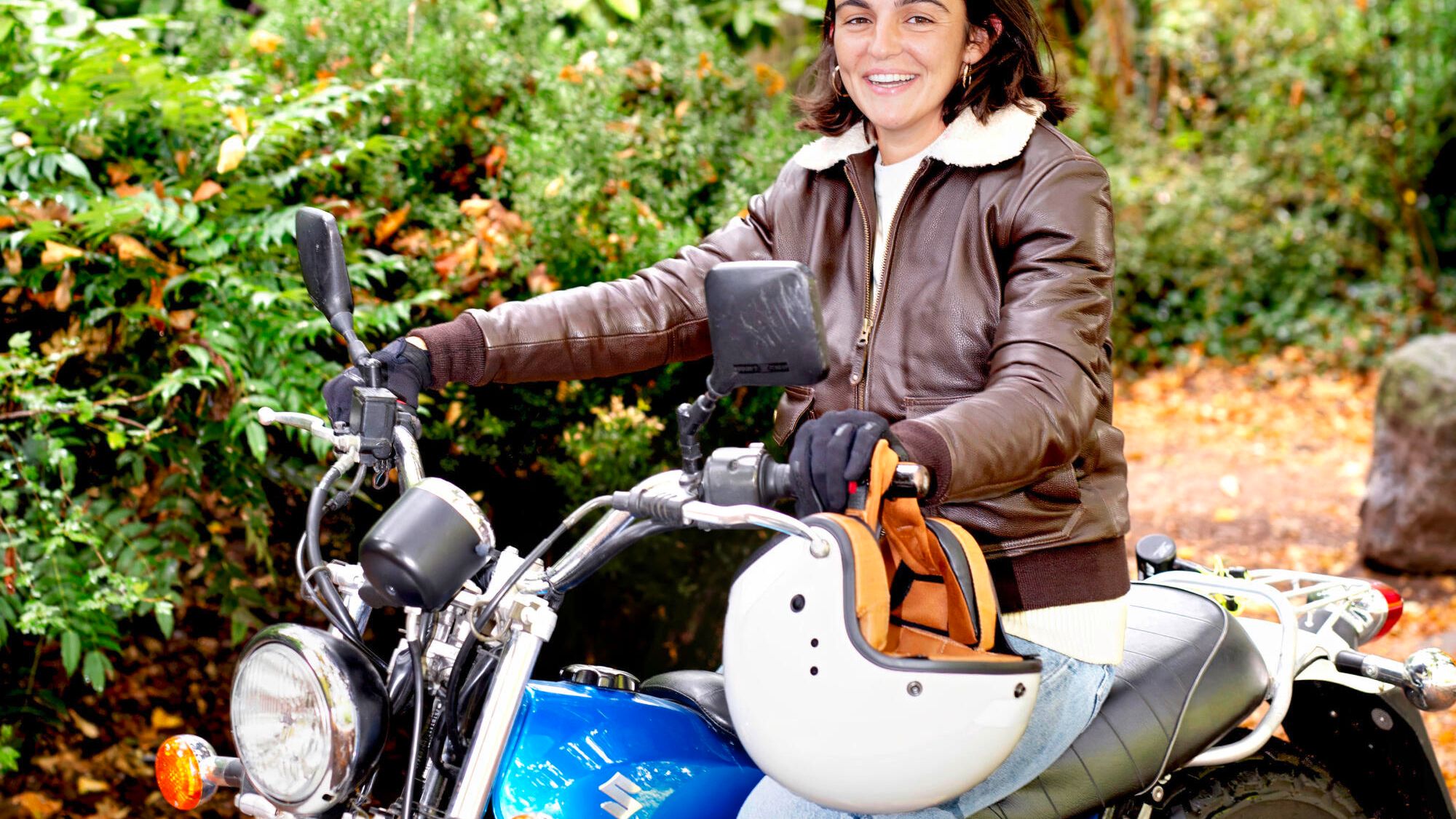
A training later, here it is ready to (re) discover “the most beautiful country in the world” with its 125 cc with a retro look. The appetite of Olive André, who works in Lille in the supply of supermarkets, sharpened as soon as she put her hands on the handlebars, transforming each routine journey towards her workplace in a small getaway.
“I just have to be on my machine to have a smile to your ears because it provides sacred sensations. We could feel vulnerable, but no, we master his bike and the danger! “Analyzes the one who sees in bikers” independent and resourceful women “.
That the path was long, however, to achieve such a observation. From the end of the 19th century, when the bicycle is popularized, women are removed. “Men thought that a bicycle to make a woman sterile, or, in another vision, excite it,” recalls Yoann Demoli, sociologist, specialist in mobility, lecturer at the University of Lille.
Then, when the motorized means of transport appear, we stick to women the stereotype of the bad driver. A general climate that aims to limit their autonomy. “Entering women’s mobility is a way of keeping them under control and confining them to the domestic space,” continues the sociologist.
It is even worse for bikers, who drive “in the open”, directly under the disapproving gaze of these gentlemen. “They are seen as people who transgress gender standards. Not that feminine, we attribute male characteristics to them, like the prejudices surrounding the truckers. ”
Financial brake, but not only
The cost also plays. Women, with lower income than men (22.2 % less on average, according to INSEE), more difficult to access these expensive vehicles. “They also represent two thirds of purchases from the 125 cm3 or less, less powerful and therefore cheaper than the big displacements”, illustrates Yoann Demoli.
Difficult, therefore, to arouse vocations. Thierry Chapeau, who manages the Moto-school Holidays, forty years of profession on the clock, remembers for example a student stranded in her apprenticeship by her husband who came to attend the lessons: “He was making fun of her and constantly demealed her. He probably couldn’t bear the idea of seeing her alone on a motorcycle and not on her back saddle. However, women are very good students: they listen to what we say, unlike men! ”
The material adapts
To make sure, the equipment took a long time to be adapted to the female public. Besides the motorcycles either too heavy or too high, the equipment, including jackets and pants, was not thought of for them. “For women, there were only simple variations with a touch of rose. There was nothing suitable for our size or our morphology, ”annoys Charlotte stays.
Having become a motorcycle in their thirties to break the routine of a profession in the marketing which she had gone around, she despairs of finding something to her taste. Necording the footsteps of the heavy goods vehicles, which have perceived the trend, here it launches its business, Wildust Sisters (Read box below) To create more suitable products and “convey the idea of independence, freedom and travel”.
Charlotte attaches an imperative: “Get away from the hyperfeminine image” which paradoxically ended up sticking to the skin of the motor, willingly fueled by fictional works (Read second box below) and advertising. From the “trucker” with big arms to the sex symbol, the bikers had to depart from uncomfortable images.
Once the license and the two-wheelers have been acquired, it remains to be felt armed enough to explore the roads. Maintenance of bikes, repairs, routes … So many things to learn. It is in this logic that Alice Peuple, inspired by what existed in the United Kingdom and Italy, launched a festival reserved for bikers, women and motorbikes, in 2022.
“Unlike men, we had little culture of the rally. The idea was to offer mechanical, revision lessons; To learn to raise your motorcycle well in the event of a fall … everything that allows you to be independent and to feel really confident. ”
From one edition to another-the second was held in 2024 with 150 participants, the next one is scheduled for 2026-, this Harley-Davidson lover noticed that “more and more women who put themselves on the motorcycle had no connection with this before universe. No father, brother or boyfriend to introduce them ”.
At the end of the three days of the festival are created groups of outings that will leave on the roads together. As with Violaine, Francine or Olive, the desire for escape is strong.
Full clientele
Who says new bikers says new consumers. These represented, on July 31, 15.3 % of new two-wheelers’ registrations (which includes scooters) in a market that weighs more than a billion euros, according to the AAA Data cabinet, at the origin of the two-wheeler observatory. It is a whole sector that took the fold.
Illustration with Dafy, one of the main accessories and equipment channels for the motorcycle. In ten years, sales of products dedicated to women have exploded: +278 %. Their share in turnover increased from 7.2 to 12 %.
“It is a very demanding community, which asks to have equipment planned for it,” says Justine Cohade, brand communication and marketing manager. Independent creators have rushed into the path, including Charlotte Séjourné, who created his brand, Wildust, in 2019, in Bordeaux (Gironde).
With a singular claw, it offers products “halfway between lifestyle and technique”. Today, the company records € 300,000 in annual turnover and has two employees.