What does Leo XIV’s first encyclical contain?
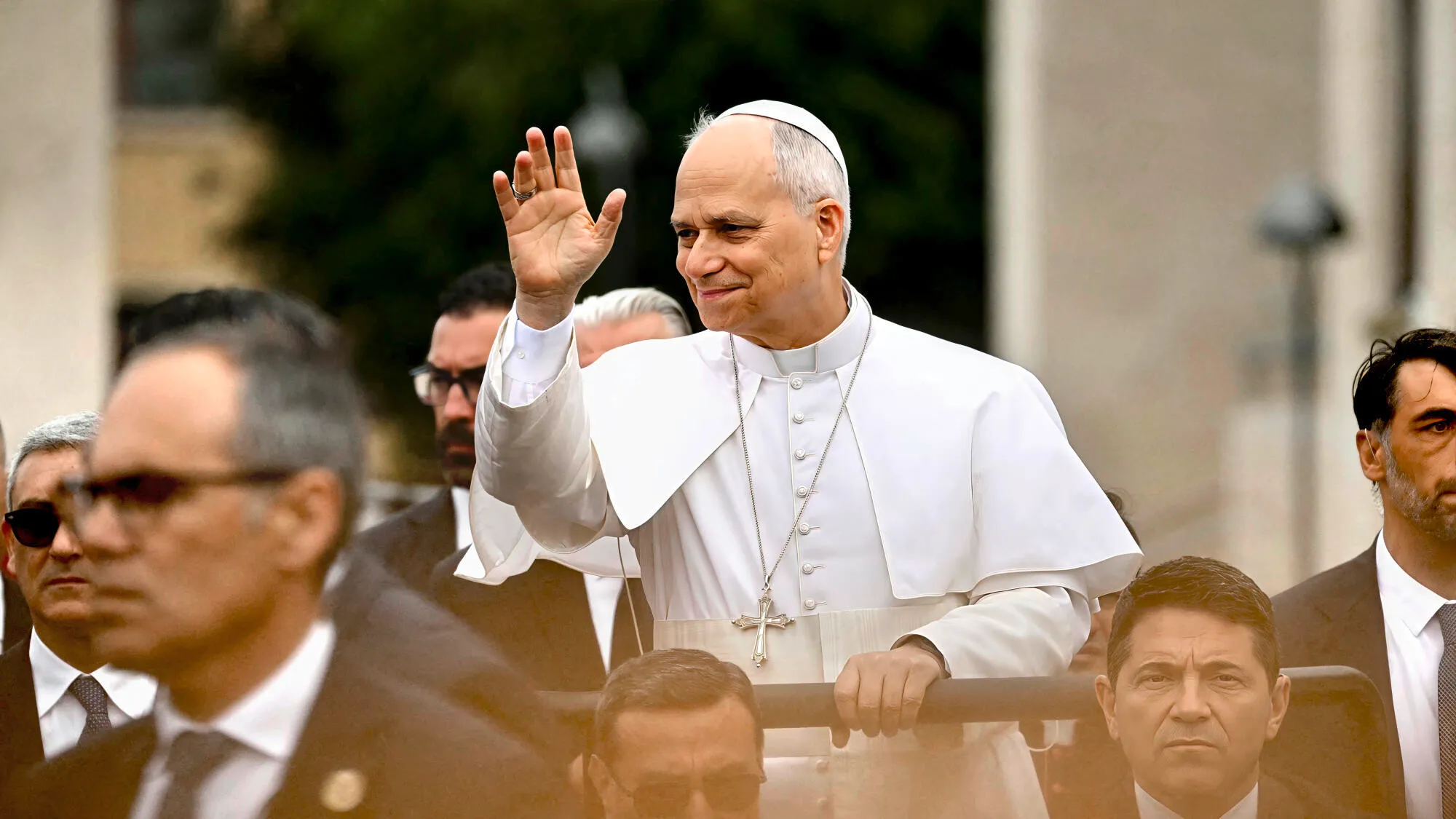
Pope Leo XIV and at his side… one of the co-founders of Anthropic, one of the main artificial intelligence (AI) structures. It is the astonishing team which, with others, presented this Monday, May 25, before the journalists gathered in the Synod hall at the Vatican, the first encyclical of the pope elected just a year ago. The scene was all the more unprecedented as popes are not in the habit of presenting their magisterial documents themselves.
Under the title Magnifica Humanitas (“ Magnificent humanity “)it concerns “the protection of the human person in the era of artificial intelligence” (AI). A bold but necessary choice, the Pope explained during the official presentation of the text, due to the “seriousness of the moment”. “At key moments in History, the Church is called to decipher new things, in the light of the Gospel and the dignity of the human being,” he insisted.
“The magnificent humanity created by God finds itself today faced with a decisive choice: erect a new Tower of Babel or build the city where God and humanity dwell together. »
Magnifica humanitas, § 1
The choice of the presence of the co-founder of Anthropic shows that the pope wants to anchor his text in practical realities, and not only in the domain of ideas. This long text (245 paragraphs, for some 200 pages), relatively easy to read, is therefore resolutely part of the current era, shaken up by an ever more rapid technological revolution. Analyzing the impacts of AI, particularly on the world of work, education and development, it is also anchored in the social doctrine of the Church, as proven by its official signing date: May 15, the anniversary of Leo XIII’s encyclical. Rerum novarum (“Always new things”), to which the first two chapters are devoted.
Aware that this is an area on which the legitimacy of the voice of the Church could be contested – particularly in the ultra-liberal conservative circles of his country of origin the United States – the sovereign pontiff begins with a long explanation justifying the origin and development of the social intervention of the magisterium. While reaffirming “the autonomy of earthly realities”, he emphasizes that it is not a question of “replacing the responsibilities of politics”, but of offering “support for common discernment”.
“True progress is always born from a heart open to others, from an intelligence willing to listen, from a will which seeks what unites rather than what separates. »
Magnifica humanitas, § 15
A call for responsibility
The social doctrine thus updated by Leo
Faced with algorithms to which Humanity could be tempted to entrust important decisions – whether in terms of employment or war – the Pope calls for “responsibility” and the regulation of these technologies. The issue is all the more pressing as the vast majority of AI tools are owned by a few private players who could have demiurgic desires.
If they are not named, the reference is clear to certain big bosses of Silicon Valley who do not hide their transhumanist temptations. How can we not think of Donald Trump and his “America first” when he criticizes “me first”? The encyclical cannot of course be limited to a denunciation of the excesses of Trumpist America. But faced with these, Leo
“What saves man is divine love which descends to the most fragile point of his history and regenerates it from the deepest. »
Magnifica humanitas, § 232
These injustices are cited, numerous. Following in the footsteps of his predecessor Francis, Léon highlights the offenses against the diversity of life and the common home, but also against several people, whom he cites by name: the miners from the countries of the South who extract the metals necessary for the machines, the content moderators, all these invisible people for whom the Pope does not hesitate to speak of “new forms of slavery”. Against all these attacks on creation and human dignity, the Pope calls – this is one of the strong words that often comes up in this encyclical – for “disarmament”. Disarming words, technologies, our reasoning is removing the logic of domination that is embedded there.
For Leo XIV, “magnificent humanity” remains the horizon, through its unalterable dignity of being in “the image and likeness of God”. And far from the supposedly endless possibilities of AI, it is precisely in its finitude that humanity is beautiful and “can recognize its own dignity and that of others as inviolable”, since it is in this “finite” humanity that God was incarnate.