why certain monasteries attract more and more young people today
One day, a question arose that changed their lives. After a few months or years, they knock on the door of a monastery and later make a promise to stay there until the end of their days. Despite religious life in full numerical decline, certain monasteries welcome numerous vocations and sometimes give birth to new priories.
Last December, Notre-Dame-des-Neiges, founded in the Cévennes three years ago by eight of the thirty Cistercian sisters from Boulaur, in Gers, was established as an autonomous abbey. Next June, twelve Benedictines from Barroux Abbey, in Vaucluse, will take over from the Trappist monks of Notre-Dame-de-Bellefontaine Abbey (Maine-et-Loire), who have become too old to continue their community life there.
A generation with a thirst for absolutes and radicality.
God’s call cannot be reduced to a few recipes. “Don’t compare monasteries. The quantity of vocations is not equivalent to the quality of monastic life,” warns Mother Bénédicte, mistress of novices at the Benedictine abbey of Pesquié (Ariège), whose forty-six sisters welcomed five postulants last year. However, similarities appear between several attractive communities today, which provide information on the spiritual expectations of a generation thirsting for absolutes and radicality.
“Each vocation is unique”
The path that leads a young man or woman to live in a fence for the rest of their life often takes detours. Sister Clémence, 30 years old, joined the Poor Clares of Poligny, in Jura, where her family comes from, at the age of 23. At 15, the testimony of a Carmelite made her think and pushed her to pray more. One day, during a party at the Poor Clares, a sister greeted her with these words: “Hello, here you are at home!” Clémence is 16 years old. The “home” resonates strangely within her. “The strength of my emotion scared me and I left,” she recalls. Then, the question of vocation comes back stronger and stronger as she pushes it away. She then makes a deal with God: either her studies take her to Poligny, or she renounces monastic life forever.
Refused in many schools, she was accepted at the last minute on the village campus, ten minutes from the monastery. Three years later, she felt a divine call “clear but without words” which she translated as: “Why am I not the first in your life?” She said “yes” a year later: “When I talk about this moment, I still tremble.” “Each vocation is unique, we cannot create boxes,” warns Sister Marie de la Croix, mother prioress of the Carmel of Ars (Ain), which welcomes two novices and a postulant among her eighteen nuns.
“There is no typical profile,” adds Father Rémy Pignal, national delegate for vocation ministry at the Conference of Bishops of France. However, similarities can emerge. Life journeys often begin within a large, practicing family, involved in scout, diocesan movements or close to religious communities, whose children do well in their studies. More and more young converts are also approaching monasteries today. Privileged backgrounds are more represented, but not exclusively.
“A sense of the sacred and the heritage of an ancient order”
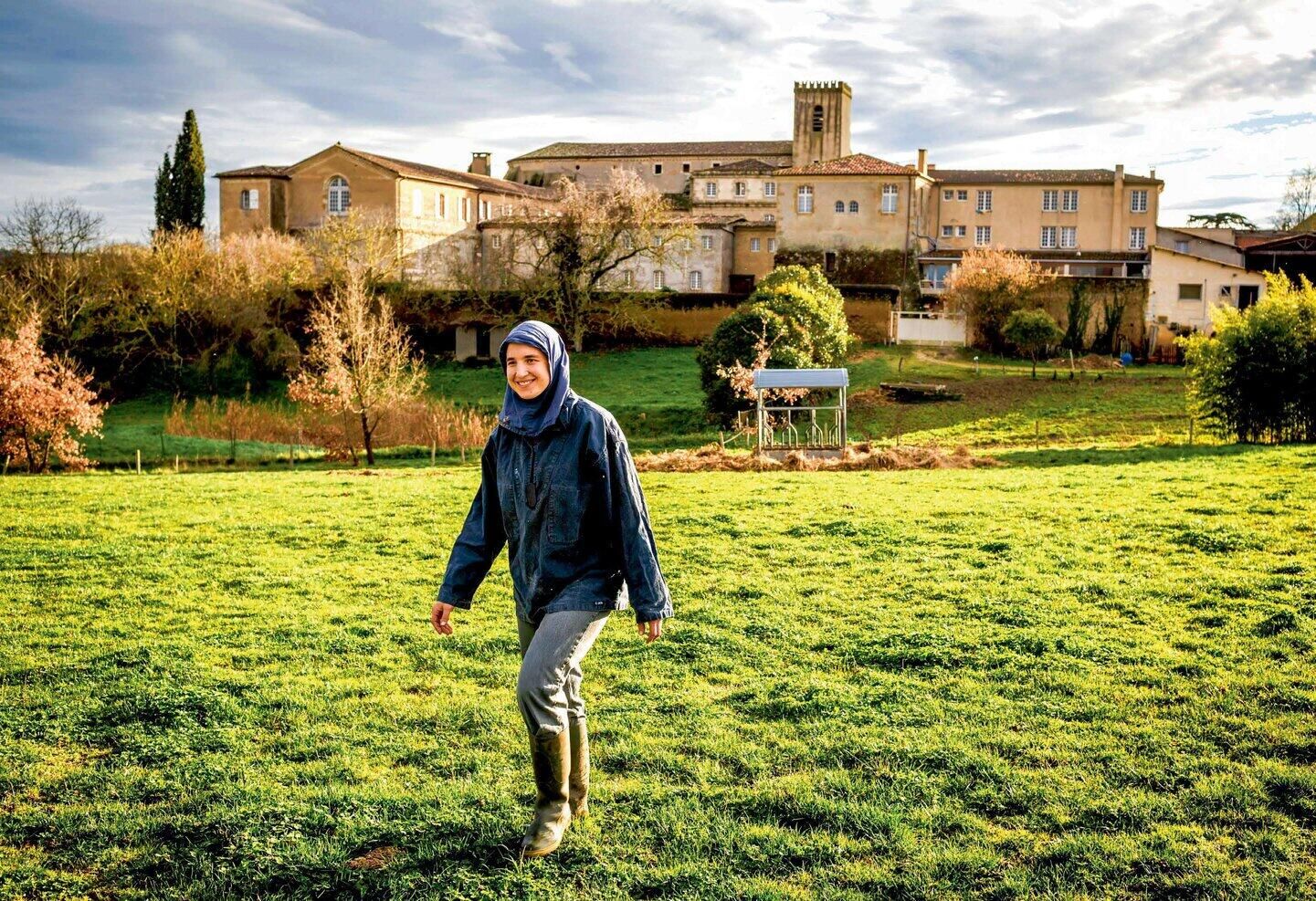
The encounter with a place is often decisive. “We came to vespers with friends and it was love at first sight,” says Sister Alice, who returned to Pesquié Abbey at the age of 22. Young people perceive there a warm fraternity and a young and numerous community. “I liked the family spirit and the quality of human relationships,” confides Sister Bernadette, who joined at 20 years old. Although radical, religious life also offers a rare human balance, between prayer, physical and intellectual work, rest, in places imbued with beauty. That of the buildings, the surrounding nature and the liturgy.
“Young people are looking for a sense of the sacred and the heritage of an ancient order,” remarks Mother Anne, prioress of Notre-Dame-des-Neiges Abbey. In this monastery, as in the community of Boulaur where the sisters come from or at the abbey of Pesquié, offices are prayed according to the conciliar rite, but in Latin, “which is more adapted to Gregorian”, explains Mother Anne. At different levels, the antiquity of the order, the habit or the liturgy attracts and secures. “Classical communities are identified in their charisma and identity. These two aspects are clear, so it may seem simpler to engage in them,” analyzes Father Rémy Pignal. They are well known in certain circles of young Catholics, while others, less numerous, go under the radar.
The desire for a demanding executive
“Young people are hungry for something strong. If I told them that they have the right to telephone and family vacations, they would be disappointed,” observes Father Louis, novice master of the traditionalist Benedictine community of Barroux, founded in the 1970s and recognized by Rome in 1989. “In all the young women I meet, I perceive a great desire for the absolute,” also observes Sister Marie de la Croix, of the Carmel of Ars. This ideal fits into a broader context. Many young people say they are tired of a world marked by dispersion, hyperconnection, instability and the difficulty of making a long-term commitment. The attraction for monasteries with a strong identity and a demanding framework highlights, implicitly, a desire for coherence, stability and transcendence in a secularized society. These desires need to be well supported, in order to prevent excesses. It is necessary to convert, over time, external intransigence into internal righteousness, explain the two priors.
Taking perpetual vows in a monastery means choosing never to leave it, praying for hours on end, remaining celibate, respecting the same schedule every day, obeying your superiors and living poorly, with the same brothers or sisters for decades. A leap into the unknown, which is not done without profound shaking. At 17, Mechtilde began studying history and geography in Paris. She is happy, surrounded by friends, active and in love. “But I had a void in my heart, the feeling of being shared,” she confides. She thinks back to the question of vocation, touched upon when she was a child. During a summer walk with the Saint-Martin community, she felt the call to religious life. “So everything I had started to build collapsed. I saw the amount of renunciations that this choice implied,” remembers the one who, at the age of 20, nevertheless chose to enter the Pesquié abbey.
A delicate discernment
Today, monastic life is more and more in contradiction with the world, where the demand for instant satisfaction of desires reigns,” analyzes Sister Bénédicte, of Pesquié Abbey. The gap seems immense, even to those who cross it. “The monastic life was completely beyond me. I couldn’t see myself getting up every morning at 3:20 a.m., putting up with the same brothers all my life, no longer having a smartphone,” remembers Brother Maximilien, converted after ten years of atheism and became a monk at Barroux in his early thirties. “Finally, when I entered the monastery, everything fell into place,” he relates.
The radical nature of the chosen life, which affects all dimensions of the person, can make discernment difficult. In addition, young people today are less mature, humanly and spiritually, note the masters of novices or the priors interviewed. Accustomed to immediacy and very exposed to the gaze of others, particularly through social networks, they become discouraged more quickly and struggle to enter into the long term. Added to this, for some, is greater emotional fragility, previous rhythms of life that are not well regulated and a religious culture that is often less solid.
Discernment requires even more time: that of studying, obtaining a diploma, being around the community, being formed and waiting before taking the first vows. “The risk is that the closed, protective structure plays on the immaturity of people. For me, religious commitment, like Christian marriage, is based on freedom,” says Sister Bénédicte, abbess of the Cistercian abbey of Notre-Dame-de-Bonne-Espérance, in Échourgnac (Dordogne). Without this freedom, serious abuses can pervert monastic life. Radicalism can also become a point of fragility when the requirement is not supported by a long, free and accompanied process of discernment.
The influence, a risk to be assessed
In communities that may have appeared healthy and holy, this beautiful appearance fostered an unhealthy submission that destroyed lives. In July 2025, The Cross revealed a sectarian drift lasting several decades in the Trappist abbey of Sept-Fons (Allier), where many young adults entered. On January 15, a report* published by an independent commission described forty years of abuse, from the 1970s to the 2010s, among the Benedictines of the Sacré-Cœur de Montmartre, who also benefited from numerous vocations. The sisters suffered psychological influence which took the form of “manipulation, arbitrary decisions, verbal and sometimes physical violence”.
Aurélie, 50 years old, left at 39 after twenty years in the community, experienced this. His free will could not be deployed, due to lack of the necessary maturation time. “I had a spiritual thirst, the desire to give my life to the Lord, and also the deep desire to get married. When I met the sisters, I wondered why they were so happy. Very quickly, the mother prioress scheduled my entry into the community, under the pretext “that one does not waste a vocation”. I only understood much later that there had not been discernment, but control.” In religious communities, the link to the rest of the Church and the existence of well-informed external perspectives are therefore necessary to stem potential abuses.
“A radical gift of self so that life grows”
However, the existence of abuses does not justify viewing all monastic communities with suspicion, whether they seem more radical or more discreet. In all these places, young adults give their lives, seeking happiness for themselves and others. What drives them deep down, the burning heart of their vocation is not easy to put into words.
“The attraction of a love whose extreme is reflected in the contemplative life,” sketches Sister Clémence. “The same ideal as when I went to the hospital during my medical studies: a radical gift of oneself so that life grows,” explains Sister Alice. The attraction for the beauty of the landscape, the liturgy or fraternal life is not enough, believe the masters of the novices met. Everything gets boring one day. “Some come back for clothes,” notes Mother Bénédicte. But we must remain for Christ.”
Stages of entry into monastic life
→ The aspirantate: Time spent attending the monastery (for one year for the nuns) and interviews with those in charge.
→ The postulate: Inside the community, start of training. The postulancy lasts at least one year for the nuns.
→ The novitiate: This period begins with getting dressed. Formation and discernment continue for two years.
→ Simple (or temporary) profession: At the end of the novitiate, the first vows of poverty, chastity and obedience are taken, for a period of three to six years.
→ Solemn professions: These solemn vows bind the nun and the monk for their entire life.
Source: Instruction Horns (Vatican, 2018).