
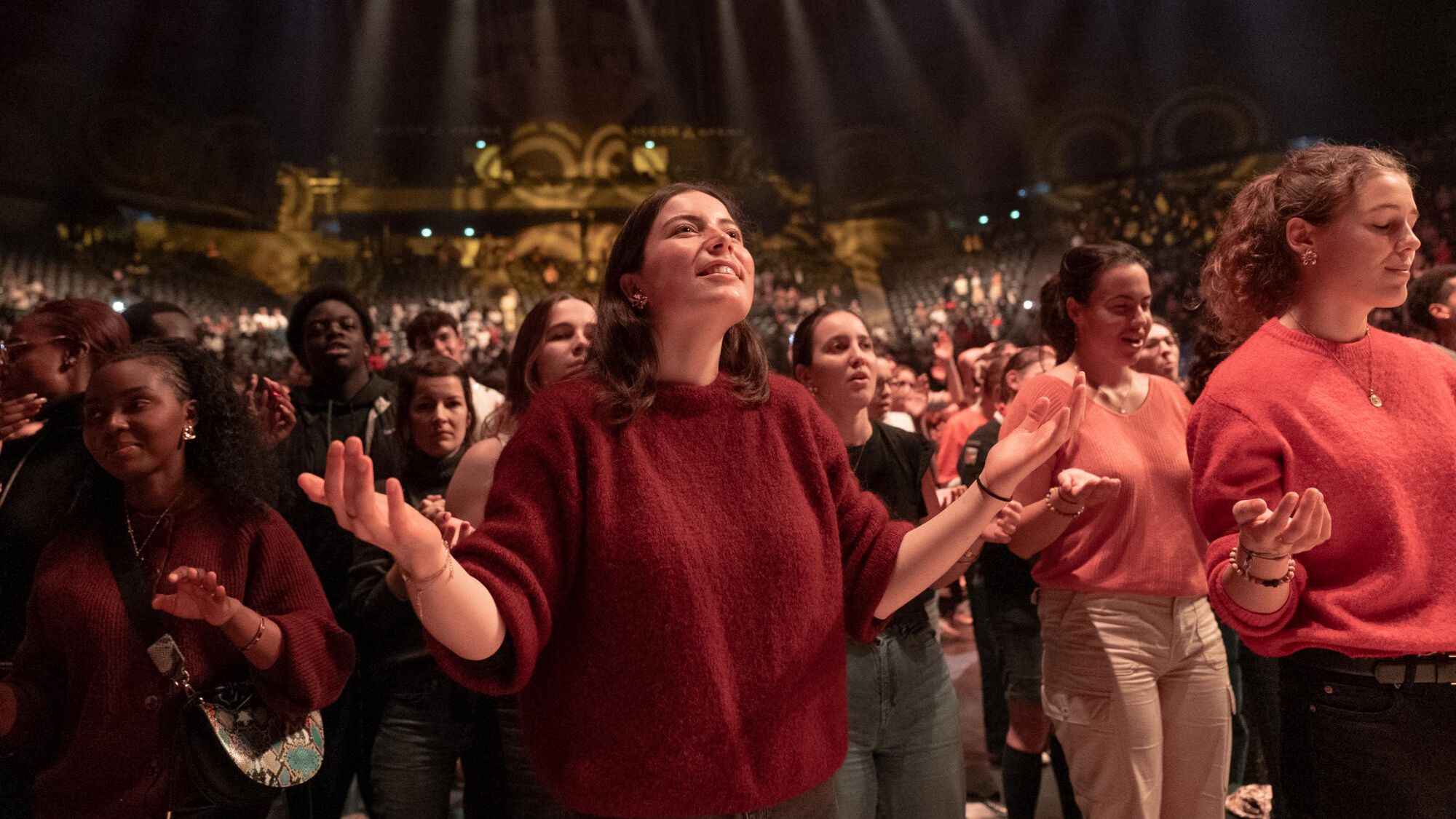
in France, more than 6 million Catholics are involved
By counting and recounting the number of children in catechism or participants in celebrations, Catholics in France are feeling hard the long wave of secularization which is engulfing this country with ancient Christian roots. If the elders, often trained by Catholic Action networks, hold the torch of the practice, their children and even more so their grandchildren rarely come to light a candle in an empty church.
However, the survey carried out by Ifop for the Bayard group (publisher of Pilgrim) demonstrates a more complex vitality. The three million regularly practicing Catholics must be added to other forms of Christian “practices”, through social, educational, catechetical and charitable commitment; or three and a half million believers, less regular at mass but committed actors.
Against all odds, one in ten French people testify to a Catholic faith made up of humanist, united and generous values, in favor of living together and the common good. Many of them are rooted in a life of prayer, celebration, reading God’s Word, and silent meditation. The results of our survey give us a much less gloomy picture than what the reduction in Sunday practice has shown us until now.
Methodology
This major investigation carried out by Ifop for the Bayard group continues similar work launched in 2016. An approach which focuses on the reality of the practice of committed Catholics today in France.
In mainland France, 2,159 people aged 18 and over were questioned. In this sample were distinguished 1004 regularly practicing Catholics (PR, who go to mass at least a few times a month) and 1155 occasional practicing Catholics (PO, who participate less in celebrations but are involved in the Church or society). This questionnaire was carried out online between April 14 and 29, 2025.
1. Family photo
It’s a beautiful snapshot of the Catholic world in France. Of course, over the years, the ranks have thinned: now less than half of adults in France consider themselves Catholic (46%)! If the older generations of Catholics have weathered many storms, it must be noted that, among the youngest and active, religious practice is largely resisting, and is even being renewed.
In France, the history of the country had created regions that were more religious than others. This is no longer true today, as shown, for example, by the case of Brittany. As for the predominance in Île-de-France, it is undoubtedly linked to the fact that most Catholics practice first in the church near their homes: in this densely populated territory, there is no shortage of nearby churches.
2. What remains
The transmission of the Catholic faith remains first and foremost a family affair. Not out of social conformity but because it structures a relationship with the world. This is evidenced by the great generosity of annual donations from practicing Catholics. Is it any wonder that the Catholics who go to Mass the least – out of disappointment or fatigue – are also the most suspicious of the ecclesial institution? Because, alongside the religious dimension, Catholicism brings together people sharing deep values of solidarity.
It remains to transpose them into the political space: if the most practicing Catholics vote more to the right and the others, more to the left, it is because, undoubtedly, we have not finished giving back to Caesar what is Caesar’s. This difference in sensitivity is also expressed in the intimate connection to the figure of Jesus: some are more sensitive to the divine dimension of Christ while others are more attached to his humanity.
3. Lines that move
Have today’s Catholics moved beyond some old recurring debates? Tolerance towards the Latin Mass seems to testify to a sincere desire for openness between practicing Catholics, even in diversity. This is undoubtedly good news, especially if the small minority attached to this rite knows how to play the card of pastoral openness and not withdrawal into identity.
Because, for the rest, most Christians show themselves to be in dialogue with the society in which they live: very connected to social networks, eager to be informed and long-term readers, they are sensitive to the place of women in society and in the Church.
Firstly through a true recognition of their charisma and their commitment, but also, for many, to the point of considering a female priesthood. Unless the turn of the question, evoking gender equality, guided the answer?
4. What questions
What characterizes practicing Catholics, even more than their Sunday practice, is the diversity of their spiritual practices: prayer, alone or with others, adoration, spiritual retreat, reading the Bible. So many experiences which maintain their desire to meet God in their commitments and in the secret of their hearts. No wonder the experience of catechism, of transmitting the faith to others, is quite common.
Unless some respondents mention the years when they themselves were catechized? One of the direct fruits of this transmission of faith is an openness to others, limited on ecumenical questions, more keen on those of the most vulnerable populations. The question of migrants is thus first read in the light of active charity before deciphering it as a political challenge for the country.
3 challenges for tomorrow
- A feeling of minority
Having become a minority, Catholics express growing concern about Islam in France: 72% say they fear its expansion, and 56% consider it “dangerous”, a perception that has increased significantly since 2016.
- Openness to evangelicals
Between 6 and 10% of the faithful have already participated in an evangelical Protestant cult. A sign that these communities are active in the territory and practice broad hospitality and sometimes perceived as proselytizing.
1 in 5 practitioners feel close to charismatic communities. But more than half of casuals do not know them. A paradox for structures very oriented towards evangelization.


