“For the clown, the hen is a master”
You just performed on stage with nine chickens… Did everything go as planned?
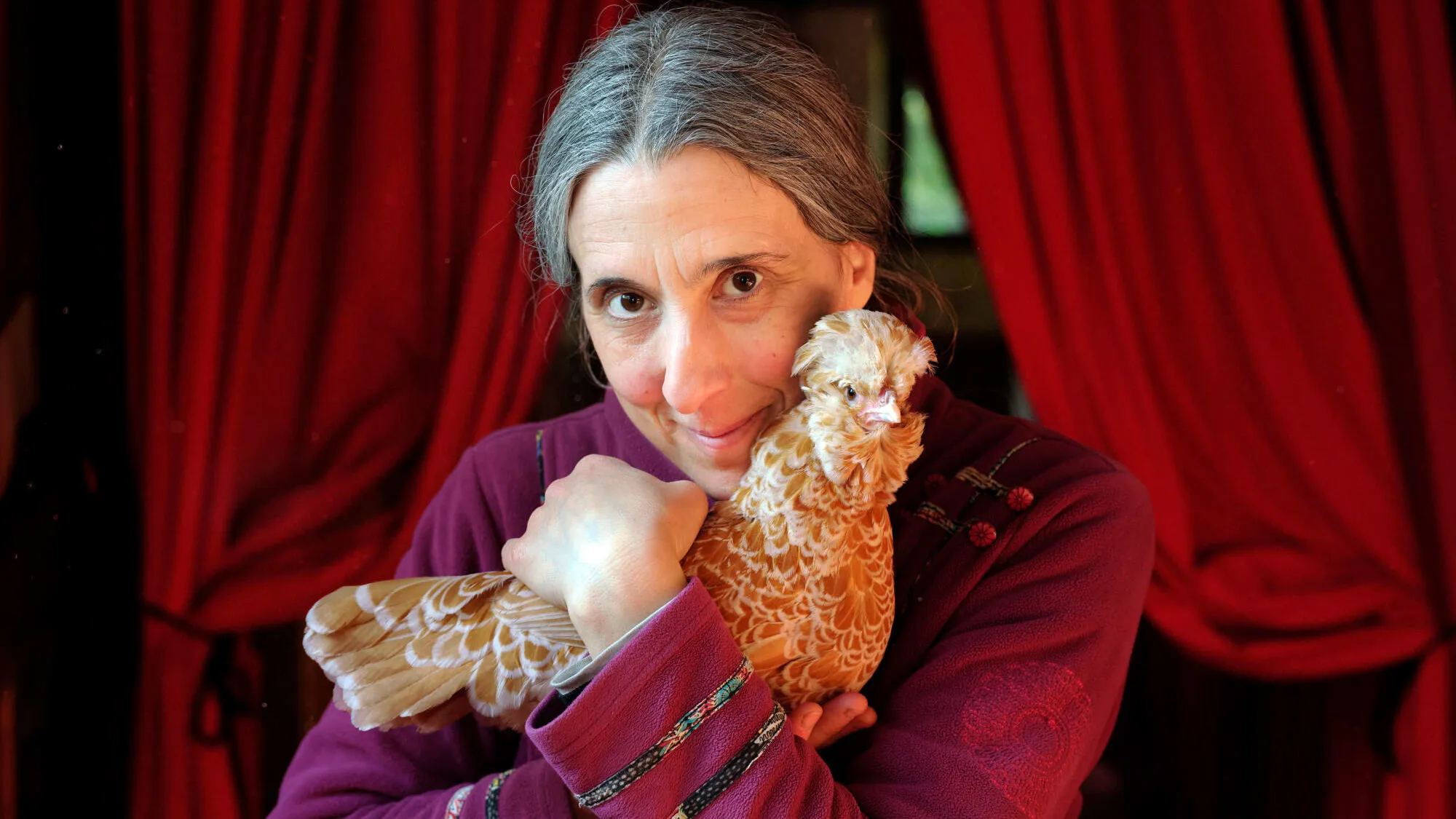
Yes and no! Everything is unpredictable in this show based on the pleasure of playing together. Chickens like to repeat certain actions because they have a lot of memory. But this unpredictability is organized: there is a text written by a theater author, François Cervantes, and a setting, this house inspired by Howl’s Moving Castle by director Miyazaki (Japanese film, released in 2004, editor’s note).
I know each chicken, and I play according to their skills and desires. Garlic, for example, likes to undo the laces. And there is the unexpected, like when Granpapatte jumped on my back earlier, while I was bent over, setting up small stools. She had the idea, and it was joyful. It’s not training. It is a partnership in which they are free to do or not, to have desires, to take their time.
You still give food on stage as a reward for an action…
This food is not subject to the completion of an action. It’s not a reward, but a way to communicate with them. Because a chicken feeds all the time. To lay eggs, she must eat four times the weight of an egg during the day. If they don’t want to do it, they won’t do it, even with little mealworms that they love! They have strong personalities, that’s what I love.
Are there any repeats?
Not strictly speaking. I spend my life with them, and it is from my observations that I construct scenes. For example, in the garden where we live in the Dordogne, I noticed that when one of them finds a large slug or a snail, it runs away and lands aside to tear it into pieces.
When the other chickens see this, they want to steal it from him and it leads to a very comical chase. In the theater, they reenact this scene with a large piece of noodle instead of the slug.
You began your career as a circus tightrope walker. How did you come up with the idea of playing with chickens?
It’s the chance of a meeting. One day, to help out friends, I went to look for a batch of chickens in Limousin, and among them, there was Ariane. It was just after I became a theater clown, at a time when I was looking for how to articulate that with wire. I don’t know how to explain, but Ariane, who I later named, touched my heart. I wanted to keep her with me with the idea of making yarn together.
Is that what you did?
I was given training advice, but I didn’t like it, so the project veered towards something else. I looked for ways to build a relationship with her. I brought in other chickens so she would have company and, little by little, it grew into a flock. I didn’t know anything about chickens, I didn’t think I would experience all that with them.
How do you “cast” your troupe?
They gave me some, and I went to get others from the Ferme de Keres (Côtes-d’Armor), which breeds ancient breeds. Because I have had problems with breeds of laying hens that have a short lifespan. It is Pascale Nuttall, the breeder, who observes them and identifies those who have a particular connection to humans or a strong personality.
I take them at 7-8 months, then I observe them. Edwige, for example, doesn’t want to do anything. Just walking around with me and me chasing him. So, in the show, I just do that. She wants it to be simple.
Circuses must gradually get rid of their animals, which will soon be banned on stage. Aren’t you going against the grain?
Chickens are not wild animals and therefore not affected by these bans. They have been domesticated for a very long time. The man realized that the more he fed her, the more she laid eggs. Little by little, they became stuffy and lost the ability to fly. An interdependence has been created over time.
They need humans to protect them, and we need them to feed us. In this show, me, the management, everyone adapts to them. We share a moment as equals between living beings. I have no influence over my chickens, as is the case in circuses. It’s rather they who, sometimes, have it over me! (laugh). Men and chickens are very different and do not have the same skills and abilities. But, like us, they have emotions.
For ten years, you have lived with chickens almost every day. What have they taught you?
To fully love beings very different from me. All the hens in the flock waited until I was with them to die. In my eyes, this is the most obvious proof of a bond of love between us, a bond that goes beyond just feeding.
Yesterday, Barbara died. Just before the show started, she wanted to go lay eggs, something she hadn’t done in at least a year. I left her alone, she didn’t come on stage. When I returned, she was so proud to show it to me. I also saw that she wasn’t doing well, so I took her in my arms and there she died.
Barbara was a brilliant warrior who everyone loved on stage. And she finished just after a show at the Cartoucherie (converted into a place of theatrical creation by Ariane Mnouchkine in 1970, editor’s note), in Paris! As a photographer present at the time told me, it was Molière! (laugh) I was torn between great sadness and joy that she died a death like her personality.
“I have no influence over my chickens. It’s rather they who, sometimes, have it over me! »
Johanna Gallard
Isn’t the place for chickens to be in a henhouse?
With us, they live freely in the garden. With them, I learned to balance the different times between rest at home and touring. It’s because something special is happening between us that they want to be there, on stage. When traveling, I do everything possible to create an indoor garden where they feel good. But, after a while, they would get tired of it. So, we never do more than four days of performance in a row.
Do you still eat chicken?
At first, I was able to make sense of things, and I ate some. But after caring for my first chicken and then watching her die in my arms, something shifted inside me and I never ate chicken again. On the other hand, I enjoy their eggs. It’s a gift they give us.
What do they bring to your artistic experience?
The hen, for a clown, is a master. They have an incredible presence. On stage, if I am not in close contact with them, I no longer exist, because they are the ones the audience watches. Theater clowning is a demanding artistic job, requiring you to be fully in the moment and accept whatever comes. They taught me not to try at all costs to do this or that, but to accept what they offer and transform it for the public.
“The chickens have an incredible presence on stage. »
Johanna Gallard
What is the clown’s mission today, in your opinion?
Remind us that all living beings are sensitive beings, fragile and clumsy too, and allow us to laugh about it. My clown character, Ant, is focused on paying attention to the little things that are important, but overlooked. Like chickens, which are at the bottom of the ladder.
We say “stupid as a chicken”! The theater clown listens to his inner being. He seeks to be in the right place, as if on the edge, in his presence to himself and to others. This is the journey of a lifetime.
What does falling off the line mean for the clown you have become?
Wanting too much to direct, to control, to “make an effect”. There, we are no longer in the living.
The biography of Johanna Gallard
- 1978. Born in Les Lilas (Seine-Saint-Denis) to a musicologist father and a painter-sculptor mother.
- 1981. Discovers his vocation by seeing a tightrope walker.
- 1986. Entrance to the National Circus School.
- 1996. Cirque Joseph-Bouglione for four years of touring.
- 2002. Creation of his company Au fil du vent.
- 2015. Discovery of the theater clown and meeting with the Ariane hen.
- 2017. The flight of the anthis first show for chickens and clowns.
- 2023. Creation of the show in Dordogne To be alive. Words of the birds of the earth.