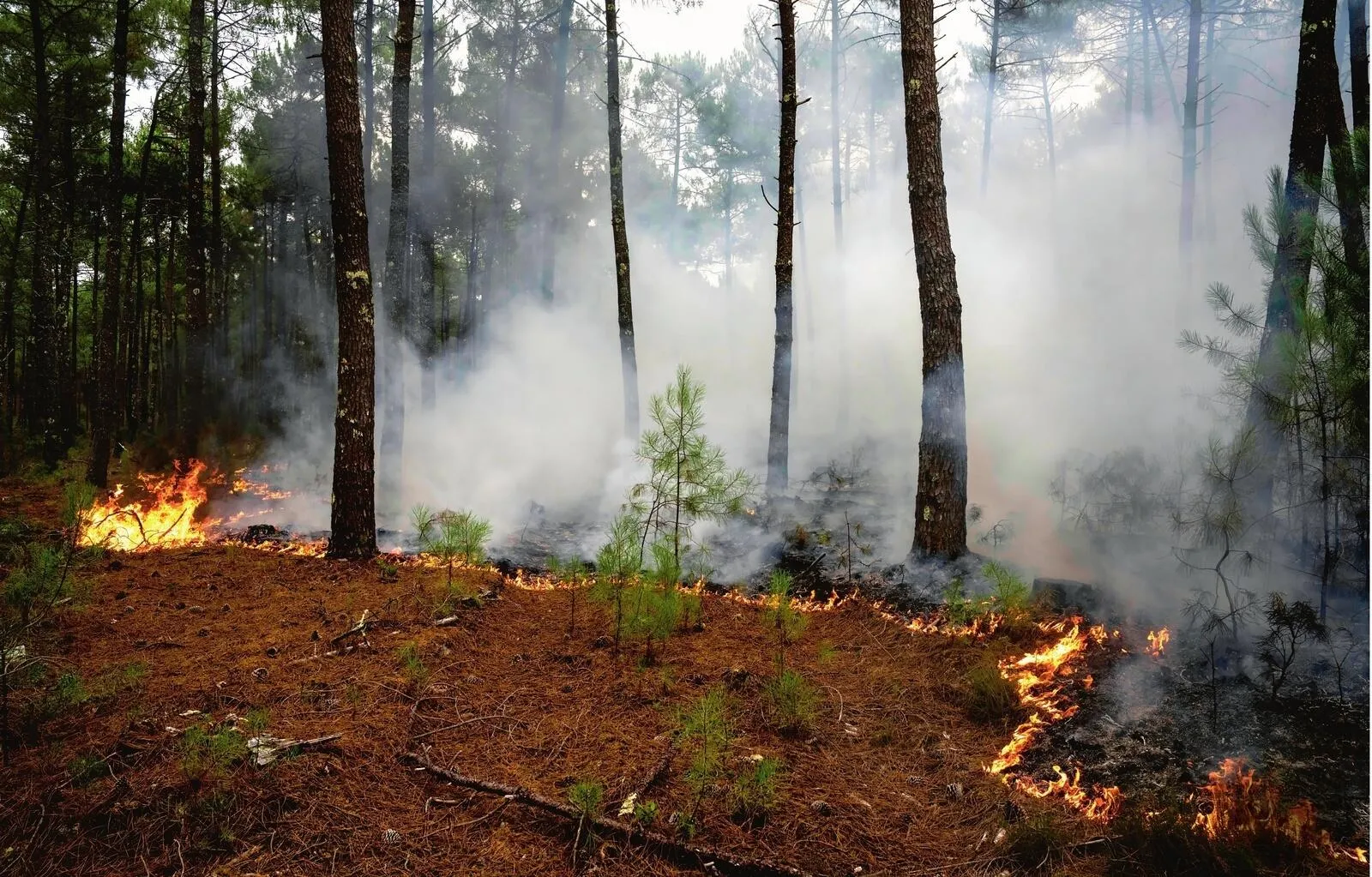
Landes: the forest that France sees burning
Pines emerging from the sands
On the A63, about twenty kilometers south of Bordeaux (Gironde), three carefully designed brown signs follow one another to praise the charms of the Arcachon basin. Just behind, the “Landes de Gascogne forest” has only a sober brown rectangle and a few white letters indicating its name. And yet, you just have to cross the curtain of pine trees that border the highway to travel beyond the clichés that stick to this singular territory.
Because the forest is rarely a destination: most motorists cross it as quickly as possible, to get to the Côte d’Argent, the Pyrenees or beyond. Often with the only memory of crossing an immense and uniform space. The flames of this summer will have at least had one virtue, that of reminding us that behind this monotony lies the largest cultivated forest massif in Western Europe, whose history is inseparable from fire.
“I have never seen anything as boring as these cursed moors,” lamented François de La Rochefoucauld in the middle of the 17th century. Long before him, in the 12th century, it was The pilgrim’s guide to Santiago de Compostela who emphatically warned: “It is a desolate country, where everything is lacking: there is no bread, no wine, no meat, no fish, no water, no springs. »
The Landes de Gascogne are a large sandy triangle which stretches for nearly 200 km, from Soulac-sur-Mer (Gironde) to Tarnos (Landes) and plants its tip in Lot-et-Garonne. Since the Middle Ages, they have been seen as a space to be civilized. “The inhabitants aroused incomprehension, because they ate rye instead of wheat and lived near marshes considered unsanitary. But they were adapted to their environment thanks to a highly developed agropastoral system,” explains Thomas Martel, head of the conservation department of the Marquèze ecomuseum.
In Sabers (Landes), this open-air museum dotted with traditional houses, sheepfolds and perched henhouses recreates an airial: a grassy neighborhood near a river where masters and sharecroppers lived together. It immerses us in a way of life based on the breeding of local breed sheep and sheep. These animals fed on the vast moors whose horizon touched the sky, watched from the top of their stilts by the famous shepherds that the photographer and native Félix Arnaudin immortalized.
“The manure, collected from the sheepfolds, made it possible to fertilize poor and acidic soil, and to cultivate rye and millet. Meat and wool were ancillary products,” underlines Thomas Martel. Two centuries later, the landscape that the French know today is about to be born. The ancestral subsistence economy was turned upside down by the law of 1857, promulgated under Napoleon III.
It then requires municipalities to drain their wetlands and plant maritime pine, already cultivated in coastal areas for the harvest of its resin (here called gem). As these costly works are beyond their reach, the municipalities sell the moors to private owners so that they can carry out these developments.
This is how, apart from a few plots of oaks along the watercourses and scattered across the massif, the maritime pine, the Pinus pinaster an indigenous species adapted to the local soil and climate, now reigns over more than a million hectares. A production forest, to which Pierre Vives wanted to dedicate a discovery center, in the village of Garein.
“Crossing the country at 130 km/hour, few people guess the 36,000 jobs and numerous products generated here by pine. The Landes are not a desert! » proclaims this former forestry supervisor for the Gascogne paper group. And an entire economy is affected by the flames: forest owners, sawmills, paper mills, silvicultural work companies, etc.
After the golden age of resin which lasted until the beginning of the 20th century, it was the exploitation of wood which offered a vital economic outlet to the territory. “Everything is good in pine,” explains Pierre Vives, 84, as he walks through the Graine de forêt center. Depending on its age and quality, the trunk is used for construction, furniture or the paper industry. The stump is crushed to produce forest chips to power collective boilers, the needles are distilled to make perfumes. »
But does the monoculture of maritime pine, geared towards industry, nevertheless make up a forest, with its diversity of species and associated species? The gigantic fires of recent days have rekindled this question.
Lagoons against fire
Seen from the country, no doubt. Moreover, not far from the center, a walk on the educational trail allows you to grasp the nuances of a landscape alternating young pines, older pines, oaks and alders bordering the streams. At their feet, depending on the humidity and the nature of the soil, grow gorse bristling with thorns, soft callune heather or verdant ferns.
“It’s a tree plantation which is also a forest,” confirms William Caudron, project manager at the Landes de Gascogne regional natural park. After the fires of 2022 which ravaged nearly 30,000 hectares in the south of Gironde, a biodiversity diagnosis made it possible to identify more than 2,000 species inhabiting the park’s forest massif. They are mainly present in open environments or in water.
In Saint-Magne (Gironde), hidden among the pines, lie black water lagoons born 8,000 years ago. True mirrors held up to the proud beauty of the pines, they form an intimate landscape, to be approached on tiptoe as it is rich and fragile. “Be careful, you risk crushing sundews, these protected carnivorous plants,” warns William Caudron, pointing to the peaty bank where life proliferates according to the seasonal fluctuations of the water table.
Another world, far from the logic of profitability of forestry? Not so sure. “Wetlands are reservoirs which help to regulate pest attacks on pines and which also slow the progression of fires,” underlines the specialist. This is also the case for deciduous trees, such as tauzin or cork oaks, which several programs are trying to establish more widely in the Landes massif, along roads and forest trails, in order to slow the advance of the flames.
Because since the beginning, fire has been the sworn enemy of the Landes de Gascogne forest. The fires of summer 2026 are an unprecedented disaster in terms of the number of people evacuated and the extent of the areas burned. But fire has accompanied the history of this massif since its creation.
The shepherds in revolt against the new pine plantations depriving them of moorland for the sheep sought to burn them. The big fires of 1947 and 1949 (in which 82 people died) left a lasting mark on memories, as evidenced by the Maison des Amis de l’Estupe Huc (“put out the fire”, in Gascon) in Luxey. The visitor discovers the ingenuity and energy deployed to protect these pines to which the inhabitants of the forest are emotionally attached, beyond their economic value.
In the 1930s, the Luxois Jean Bordes designed a system of screws transportable by bicycle to pierce the alios (impermeable stratum of the Landes soil) and reach the water table. “In the event of a fire, these boreholes made it possible to have water available immediately on site instead of traveling great distances. This technique is still used today,” testifies Thomas Ducos, firefighter and volunteer guide in this unique place which also presents American military vehicles transformed after the war into fire trucks.
Since then, firefighting has continued to improve. But this summer’s fires, especially when they break out after three hellish heatwaves, are a reminder that no system is infallible.
Seen every day by thousands of motorists, the brown signs whet many appetites. What territory, municipality or monument would not like to enjoy such publicity? But administrative law watches over, and the constraints are numerous. The Interministerial Instruction on road signs lists them. Among them, a “principle of neutrality” prohibits “sites of a philosophical, political or religious nature” – with the exception of historical monuments, such as cathedrals. It also stipulates that, to be represented, a personality must be “consensual”. Not easy to arbitrate… Ultimately, it is the prefect who decides. And who pays? Design, installation and maintenance represent several tens of thousands of euros per panel, shared between motorway companies, local authorities and even private partners. In what proportion? Hard to know. We are in the gray area of brown panels. To be continued…
Victor Macé de Lépinay