
Summer 2026: what solutions for French agriculture?
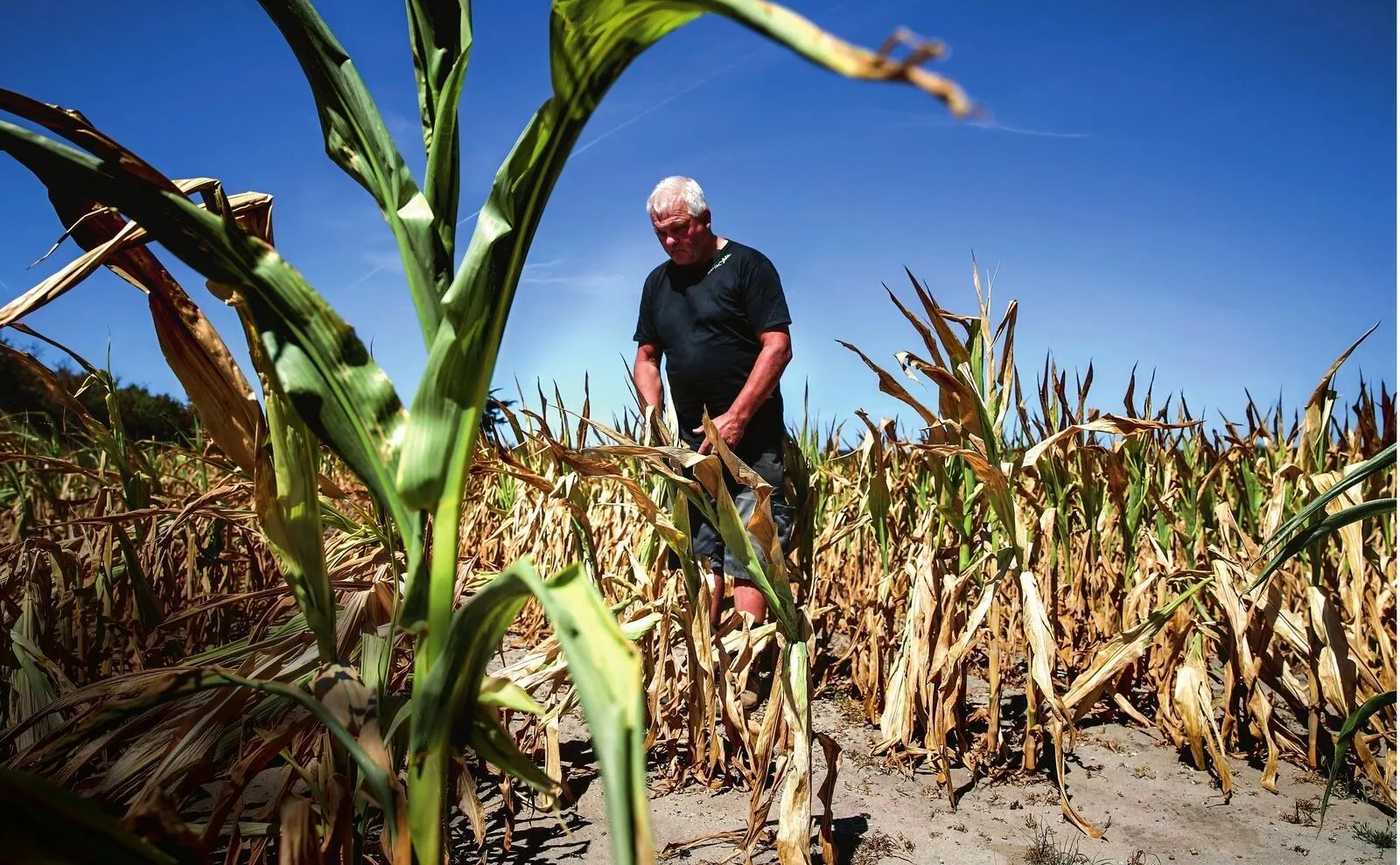
Five heatwaves, three heat waves, 83% of the territory affected by a drought decree and multiple 40°C appearing on the meteorological map of France… The summer of 2026 accumulates sad historical records. “I knew that such climatic extremes were coming but I did not expect to see them so quickly,” summarizes Mathieu Courgeau, 41, dairy farmer in Vendée. A feeling of astonishment widely shared in the agricultural world, which appears to be stunned for two to three months without water or respite. Not a corner of France has not suffered.
Indeed, apart from summer fruits (apricots, peaches, nectarines, etc.), all sectors have been affected by drops in yield. Particularly marked fall for corn (-18.5%), permanent meadows (-37% grass growth on average), potatoes (-13%) but also and especially vegetables, with losses ranging from 10% to 100%. “Spinach has burnt leaves, sometimes making it impossible to process, while carrots, beetroot and onions show growth stops and very low yields,” explains the inter-professional organization for canned and frozen vegetables, Unilet.
As for livestock, it is suffering with high mortality in poultry and pigs due to the heat in buildings. Furthermore, a large part of the winter fodder stocks intended for cows and sheep was used this summer.. Where to find what to feed your animals? All of Europe is looking for hay… “Even if this won’t catch up with everything, fodder can still grow until November,” underlines agroeconomist Jean-Marie Séronie. The extent of the crisis will therefore depend on the rain that falls, or not, in the coming weeks. »
Short-term loans
But support won’t just come from the sky. The government is also eagerly awaited to allow cash-strapped farmers to prepare for the next campaign and save farms from bankruptcy. The plan announced on September 4, 2026, called “CASI agriculture” (for climate, adaptation, drought, fire) presents fourteen measures for a total of 1.2 billion euros (read box below) . “Emergency patches, without a future strategy” according to the Young Farmers’ union, a “scandalous plan” according to the Peasant Confederation: it satisfies no one.
“In reality, only the 235 million euros whose use is in the hands of the prefects are really new,” explains Jean-Marie Séronie. But for farmers to be able to get over the hump and plan for a new season, short-term loans with rates close to 0%, guaranteed by the State, are needed, rather than subsidies. This would make it possible to meet cash flow needs which number in the billions. » Will these loans be included in the 2027 finance law to alleviate the urgency of a situation with potentially serious social consequences?
The Ministry of Agriculture itself speaks of 30,000 to 35,000 farms in serious difficulty, or 10% of the current workforce. “The accumulation of bad years creates the risk of bankruptcy,” explains Alain Carpentier, economist at Inrae.
This is particularly the case in so-called low-potential cereal areas. (located on a diagonal going from Charente to Lorraine, editor’s note) where wheat, rapeseed and barley farms have been losing a lot of money for three or four years due to low market prices and high fertilizer costs. This summer of 2026 could be fatal for them. »
A summer which in its gravity can bring to mind that of 1976. But whose meaning turns out to be very different. “In 1976, people perceived it as an exceptional event,” recalls Alain Carpentier. There, they say to themselves that this is the start of a long series. »
This awareness, which translates into anxiety in the countryside, creates additional pressure on the government. He has committed to presenting a recovery plan containing measures to adapt to climate change during the 2027 budget.
“We will have to invest in training and supporting many more farmers in practices such as agroecology,” believes Jean-Marc Séronie. It will also be necessary to finance new equipment, such as livestock buildings adapted to heat or seeders intended for no-till.”
Furthermore, after this dramatically dry summer, numerous requests for investment support for access to water are emerging, particularly in the vegetable sector. “With only 20% of market gardeners equipped for irrigation, the sector can no longer absorb such extreme climatic episodes, which now exceed the resilience of crops,” warned, in August 2026, the market gardeners united under the Prince de Bretagne brand.
The battle for blue gold has only just begun. “We will have to approach things with nuance, territory by territory, and by prioritizing uses,” argues Lionel Alletto, research director at INRAE. Because the major challenge of adaptation to climate change in agriculture is the sharing of increasingly less available water. »
Redirect aid
Finally, while the state budget is in dire straits and the emergency plan must already be financed, what resources can be invested to make agriculture more resilient to future shocks? The government could already direct the funding granted by the common agricultural policy (CAP) in this direction (more than 9 billion paid annually), suggests the Court of Auditors in a report published in early September 2026.
She deplores that France has chosen to direct these sums towards agricultural income support to the detriment of transforming farms so that they become less dependent on inputs (fertilizers, pesticides, etc.) and more adapted to the new climate.
She therefore proposes to now prioritize “the productive resilience” of the France farm. A timely diagnosis as the new CAP is in full development for entry into force on 1er January 2028. And that debates on agriculture will largely feature in the presidential campaign.