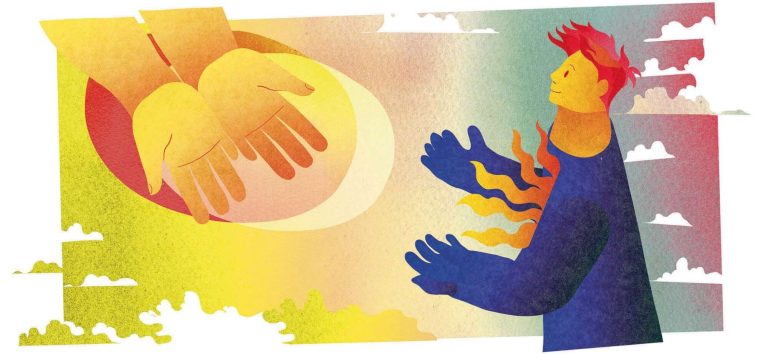
Yannick Haenel: “Teachers are lanterns lit in the night”
This novel is inspired by your years of teaching in the Paris suburbs, thirty-five years ago. Why write it now?
Several things triggered it. First, the assassination of Samuel Paty in October 2020. I followed the trial of the January 2015 attacks at the courthouse, Charlie Hebdo and Hyper Cacher, as a columnist for Charlie.
That morning, in the press corner, the phones rang all at once. Suddenly, we understood. Like crazy, I started writing a supportive text, “The Solitude of Teachers,” which Charlie Hebdo published.
Second, this book haunted me. When I stopped teaching after seventeen years, I wanted to relate this experience but, at 35, I did not have sufficient writing skills. There, I recount nine years of college with this professor, Jean Deichel, which are an incredible transposition of my itinerary.
What did you want to tell?
The fate devolved by the Republic, French society, to the teaching profession. When I started, it was an intellectual and humanist vocation. It gradually changed into social support. But I didn’t want a journalistic or sociological book, I like it to tell about the fun, the misadventures.
For me, a novel is an arrangement of images. I looked for figures, scenes, starting with the broken vase. The narrator breaks a precious vase during an end-of-year party and this is the beginning of his descent into hell. A misadventure that I experienced.
There is also the lake and the candle. Every evening, Jean Deichel goes around a lake, counterclockwise to erase the worries of the day. As for the candle, it comes from a film by Andrei Tarkovsky.
A man walks through a misty thermal pool with a lit candle, which always goes out, and he keeps doing it again. This is what teaching is: going from one end of a classroom to the other with a lit candle that keeps going out.
What meaning does this broken vase have at the heart of your novel?
It symbolizes this fault, this guilt, which teachers carry around like a ball and chain. We always leave a class saying to ourselves: “I could have done better. » Because it’s very difficult to measure the quality of your work. And my narrator is very scrupulous, even if he is at the same time a little I-don’t-care.
Your novel is effective literaryly but also in its documentary side…
I like thrillers, efficiency! I had to tell the story of the first day of a teacher, an intellectual after four years of philosophy, who worked on Hegel, Mallarmé, and who found himself completely disoriented in the Paris suburbs.
And then, afterwards, it opens up to something else. Because the classroom is an above-ground place, a symptom of everything that happens in society, but also a place where shared words are constructed. An unscathed place, where there are disasters and miracles.
“The classroom is an above-ground place, a symptom of everything that happens in society. »
Yannick Haenel
Do you act as a spokesperson for a profession?
I hope to speak for a community of teachers. You might think that nothing is more boring than the life of a teacher. I experienced the opposite. A bubbling. Permanently exposed, the teacher has the immediate result of his competence or incompetence.
On the edge, he never stops questioning himself. My project is to do justice to the teachers, to speak out about this permanent contradiction. One teacher at a time complains and says that this job is extraordinary. This intensity is rare!
Why did you become a teacher?
For love of literature. I studied modern literature, had my Capes and the aggregation (teaching recruitment competition, editor’s note) at 21, and found myself in front of the students. I loved the teenagers, their world of incompleteness in accordance with my position of imbalance. And I did my best.
My book is very critical of National Education and authority, because this is not what I experience in my relationships with others and with children. I realized that students weren’t doing their homework, so we were doing everything in class. I gave them to see and hear. The scene where the children read a poem by Nerval from which I gradually erased the verses on the board is true, it still gives me incredible emotion!
This is a very strong passage from the book, but is school always a tool for transmission?
Something broke like this broken vase. Reforms always aim at the wrong side and complicate everyone’s life. Few people realize what happens in class. This loneliness, this abandonment. Just like being a doctor, a nurse in the public service, or being a teacher means sacrificing yourself.
But there still needs to be retribution. And I’m not just talking about money, even if there is an obvious proletarianization, I’m talking about almost systematic denigration. Sometimes I tell myself that there is a hatred of the intellectual.
What is the responsibility of the institution? Has the situation gotten worse or is the original copy wrong?
The French education system does not work. Expecting young people to remain on a chair for eight hours a day in front of an imposed word and demanding that teachers policely watch over them is absurd.
It has gotten worse because our practices in society have changed. We ourselves find it difficult to concentrate. But, from the start, this verticalization of knowledge is brutal. This republican ideal, supposed to bring together in a single idea something which has continued to diversify, is obsolete. There are other models to be invented.
In your novel, there is the idea of rehabilitating this profession. Your magnificent title has its effect…
This mantra that my teacher repeats to himself on the RER to give himself courage is ambivalent: solitude is this abandonment, but also a secret force. The narrator racks his brains to transform these fifty minutes into a place of reward: bringing the most beautiful texts, even complicated ones, and making them listen and read with simplicity. Those of Marguerite Duras, Charlotte Delbo…
School is a place where we listen to language, it is therefore a place of resistance because language is being sacrificed. And even if the school is a devastated place, it is a place that holds together.
“School is a place where we listen to language, it is a place of resistance. A devastated place but one that holds together. »
Yannick Haenel
So at school, do we listen to language and not authority?
Exactly. When rap arrived, I did small performances. Students have always admired someone who speaks well. I showed them that language liberates, that it is a blank weapon that does not kill. School is undoubtedly the last place where we think that language can broaden instead of becoming poorer. Children know this, who are thirsty and hungry, want to eat.
Thirty years later, we say to ourselves: “And now we are killing them. » Can we still be a teacher after Samuel Paty, Dominique Bernard?
I think there is teachericide in progress, I dare say. The situation of teachers is dangerous. They get stabbed because they disturbed this or that doxa. There is Islamism. And also this other threat: a civilizational model which would only aim for profit. School is still free. However, capitalist society does not want this gratuity, preferring profitability…
Does the erasure of writing worry you?
Our civilization is based on writing, symbolic. Those who, to enrich themselves, want to sell us something else condemn it. Whatever the social environment, a book remains a magical object, perhaps frightening or old-fashioned. But it is from him that the children think that everything is built.
It is not for nothing that the worst people today, in politics and economics, want there to be fewer texts. THE logosthought are structured by language: if we impoverish language, we impoverish thought.
But how can we generate interest in the written word?
We can make books sexy! At 13, my daughter discovered Kafka on TikTok with an influencer: “But Kafka looks sexy!” » So she read The metamorphosisthis story of a young man unloved in his family, transformed into this cockroach that his father believes him to be. It spoke to him.
What do you think about the social media ban?
It depends on who and when. My daughter, now 16, uses her phone to communicate with her friends, to read. So it is in the language. But intoxication by images, on TikTok or Instagram, exists and, in some families, dialogue is blocked. Language is the key, and that’s why teachers are heroes, lanterns lit in the night.
Your novel is crossed by an eminently Christian thought…
My narrator is endowed with a faith, perhaps not religious but spiritual. My novel is both a descent into hell and a redemption. The question is also that of innocence, of the unharmed in us, in the sense of who is preserved from damnation.
This unharmed person is the school’s challenge. It’s not about reproducing a social model, preparing people to become good employees, it’s about helping the unscathed in each of us grow. Create fulfillment, an escape from hell in every moment.
The biography of Yannick Haenel
- 1967. Born in Rennes (Ille-et-Vilaine). Military father, childhood in Africa.
- 1988. Capes and aggregation of modern letters.
- 1989-2008. French teacher in middle school then high school, in the Paris suburbs and in Paris.
- 2007. Publication of CircleDecember price.
- 2009. Jan KarskiInterallié prize.
- 2017. Hold your crown tightMedici Prize.
- 2019. Solitude CaravaggioMediterranean prize.
- 2022. Novel The paymaster.
- 2024. Essay Bacon Blue.