End of life: these caregivers who accompany until the end
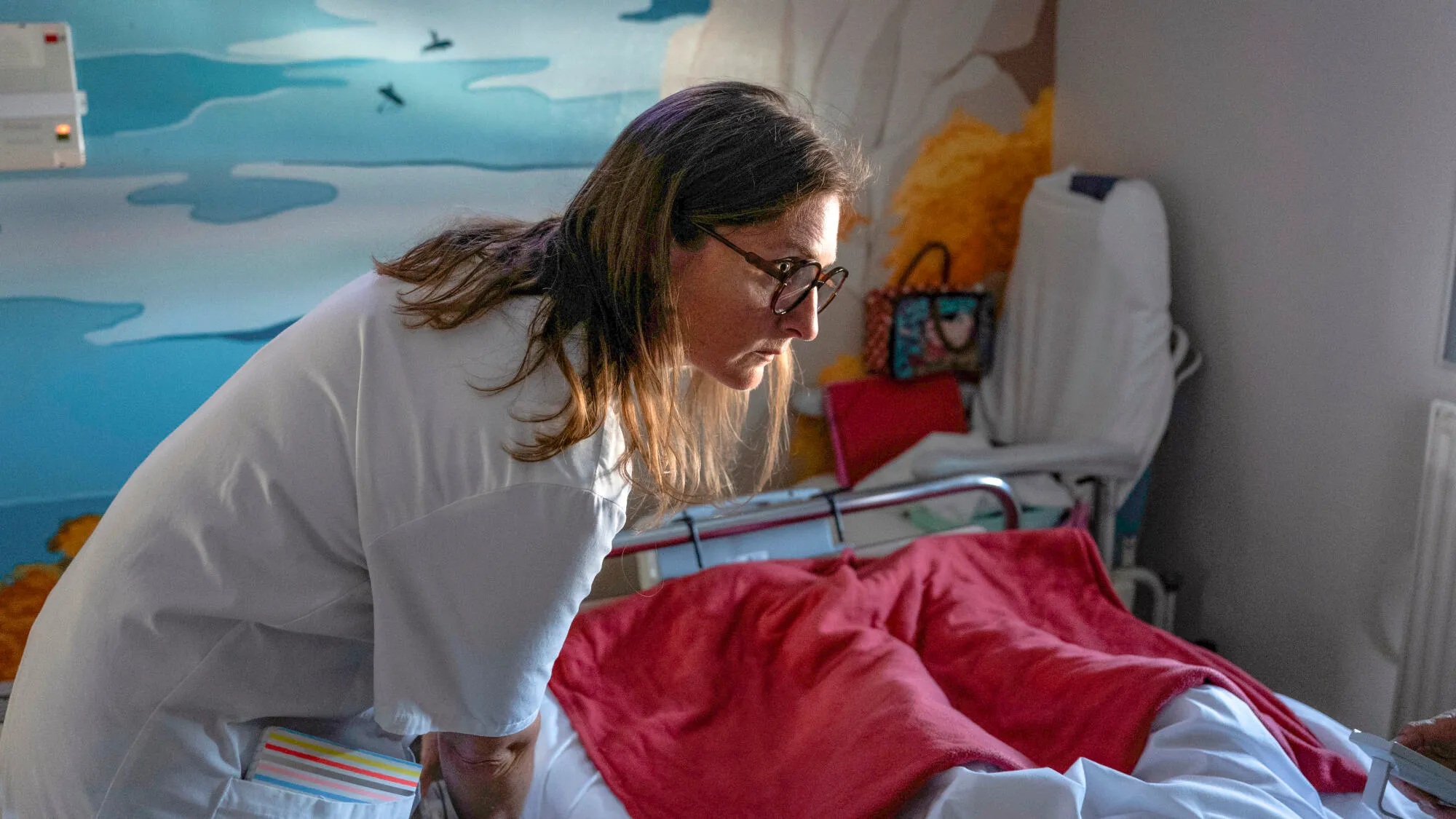
This Saturday, July 11, 2026 in Montbeton, a town of 4,000 inhabitants about fifteen minutes from Montauban, Annick visits Anne-Marie in the nursing home where she has lived since a stroke almost completely paralyzed her four years ago. Annick is a volunteer within the Association for Palliative Care and Support of Tarn-et-Garonne (ASP82), a branch of the Being-there movement. For a month and a half, the two women have met once a week.
At 86 years old, Anne-Marie no longer leaves her bed. The conversation begins about the recent excommunications of the Society of Saint Pius X, which she learned in The Pilgrim. During the exchange, Anne-Marie talks about her Christian education and her faith. “The Good Lord, we can tell him anything; he’s a friend. That’s why I don’t blame him. » Unvarnished, she speaks of the harshness of her situation: “You see how I am. » Before insisting, using another formulation: “You know who I am. » An expression which sums up the importance of his discussions with Annick and, undoubtedly, the concern for attention to people, characteristic of palliative care.
Four days after this meeting, on July 15, 2026, assisted dying officially became a right with the vote on the law in the National Assembly. As the French Society for Support and Palliative Care regrets, “its implementation will rely on caregivers who, throughout the debate, expressed their deep reservations without being able to make themselves heard.”
Federations of Catholic nursing homes and congregations such as the Little Sisters of the Poor have expressed their discomfort at having to apply a law so contrary to their vocation. Véronique Parre and Laura Lafargue, nurses in Montricoux and Lauzerte, in Tarn-et-Garonne, respectively, work with patients awaiting death.
“A gentleman at a very advanced stage of Charcot’s disease wrote on his tablet: ‘When is the end?’”, says the first, who is celebrating thirty years in the profession. The second sees a very isolated elderly patient every day, who confides her difficulty in living. “Physical and psychological suffering mix,” she explains.
More volunteers
In Laura’s office as in the Montricoux medical center, the position is the same. “We are waiting to know who will be concerned, what the protocols will be,” says the Dr Baziries, who joined Véronique in the renovated healthcare home in 2020. “For the moment, it’s still vague: we don’t ask the question. »
President of ASP82, Marion Maillard is delighted to see that more and more people are offering to be volunteers. “They range from 26 to 90 years old! I have one contact per week. We’ve never had so many. » The association is one of the opponents of the legalization of euthanasia and assisted suicide, but is preparing to offer bereavement support to the families of patients who have requested it. “The suffering changes dimension,” explains the 28-year-old young woman. If it is possible to achieve death, my suffering becomes a choice with its consequences on my family, caregivers, society. It’s a huge responsibility. The fight against suffering, what will it become? »
These questions, which will come up more and more frequently with the entry into force of the law, agitate volunteers, health professionals, relatives of patients… It is an entire developing medico-social branch, where vocations and initiatives are multiplying, which is concerned. Even in the countryside, like in this department of Occitanie. In Montricoux, palliative care situations are varied. “Most patients have cancer or are very elderly. We support them until the end,” explains Véronique Parre.
Flexibility and responsiveness
“Advances in medicine make it possible to prolong the lives of patients, but there is also a greater need for palliative care,” specifies Dr.r Baziries. The word is frightening because it is associated with imminent death, with pain, and with a hypermedicalized environment. We must deconstruct this image. » Because medical care is often minimal and boils down to “a medical bed, oxygen and the intervention of a nurse for comfort care”.
This concern not to do too much constitutes the philosophy of palliative care. “We are not in a simple logic of “diagnosis-treatment”, explains Laura. We ask ourselves a lot of questions, we discuss with the patient, their loved ones, as a team. What is the goal for this person? What is reasonable? What is additional? »
This search for maximum well-being of the patient is in perpetual reassessment: health suddenly deteriorates; loved ones become exhausted and staying at home becomes more complicated; the patient’s demands evolve…
Most people want to stay at home, but palliative care requires a lot of flexibility and responsiveness. And that’s where the problem lies. In Montricoux as in Lauzerte, we highlight the lack of beds in the hospital. Tarn-et-Garonne is one of the 18 departments that does not yet have a specialized unit: this should open in September 2026.
In different hospitals and clinics, however, there are “beds identified as palliative care”. The department is even within the national average: a little less than 10 beds per 100,000 inhabitants. “There is an increase, admits the Dr Baziries, but we start from very far away. And when we need to hospitalize a patient urgently, it is sometimes very difficult. »
The atlas published on July 16, 2026 by the National Center for Palliative and End-of-Life Care confirms this impression. In twenty years, real efforts have been made: there are almost three times as many identified beds, twice as many specialized units, mobile teams present in all departments… But the needs are also growing strongly. Life expectancy is increasing and the population is aging: 10.8% of French people were over 75 in 2025.
Lack of beds and caregivers
Palliative care, first developed for patients with cancer, is increasingly welcoming people with neurodegenerative diseases such as Parkinson’s or Alzheimer’s, or those with severe disabilities. In 2024, the State committed to a ten-year palliative care development plan. The endowment? More than a billion euros. However, it comes up against structural difficulties in our health system: lack of beds and practitioners, particularly general practitioners, high cost, unequal distribution of nursing staff.
Thus, if Tarn-et-Garonne is among the departments best equipped with nurses (more than 213 per 100,000 inhabitants), it lacks general practitioners (between 60 and 80 for the same population). “It’s a political subject,” notes the DD Florence Rigal, one of the two doctors on the mobile palliative care team at Montauban hospital. “It is the question of respect for people’s rights, in terms of access to care, to treatments that relieve them, of respect for their rights until the end of their lives, of respect for refusals of treatment. »
A philosophy of care
In Tarn-et-Garonne, palliative care is based on the commitment and coordination of stakeholders – caregivers, but also carers, psychologists, volunteers who provide visits, social workers, etc. This weaving of relationships has been going on for more than thirty years. In 1991, caregivers founded the ASP82 for the development of palliative care. Initially informal, a network becomes structured; mobile teams appear, including that of Montauban in 2004. A support and expertise team, it intervenes to support caregivers serving a patient, in hospital or at home.
“We try to bring people together to see the situation globally and make proposals,” explains the DD Rigal. “We help with the continuity of care by referring patients who need to be hospitalized to units,” adds Virginie Drezen, a nurse on the mobile team for twenty years.
If the second part of the law concerning the development of palliative care has achieved consensus, the question of means will play out in local political life, and will need to be stimulated by citizens mobilized with their elected officials. Sébastien Lecornu and Gérard Larcher also announced that they were contacting the Constitutional Council to – among other points – raise awareness about the absence of a conscience clause for health or medico-social establishments which “exclude the use of assisted dying”. This referral suspends the promulgation of the law while the Wise Men rule, and may result in partial or total censorship of certain provisions deemed non-compliant with the Constitution.
Can a patient or loved one request palliative care?
” Yes. It is possible to request palliative care or obtain information from the closest caregivers: nurse, care assistant, doctor, pharmacist. You can also contact the Mobile Palliative Care Team (EMSP) in your area directly. To find out about the organization of palliative care near you, you must first look for information in the directory of the siteparoles-fin-de-vie.fr of the National Center for Palliative and End-of-Life Care. The Caresp sites – there is one per region – also provide this information. »
Karine Trabel, project manager at the regional palliative care coordination unit (Caresp) in Occitanie.
What is palliative care?
Derived from the Latin palliare (to cover with a coat). The goal of palliative care is not to cure, but to preserve the quality of life of patients and their families. They support the patient in all its dimensions, and are complementary to the treatment: pain, nutrition, psychological or spiritual support, daily environment, aesthetics, etc. When healing is no longer possible, they intensify until they are the last provided, all medical treatment having been stopped. The patients are then “in a palliative situation”. Research has shown that they improve treatment tolerance, and therefore its effectiveness.