
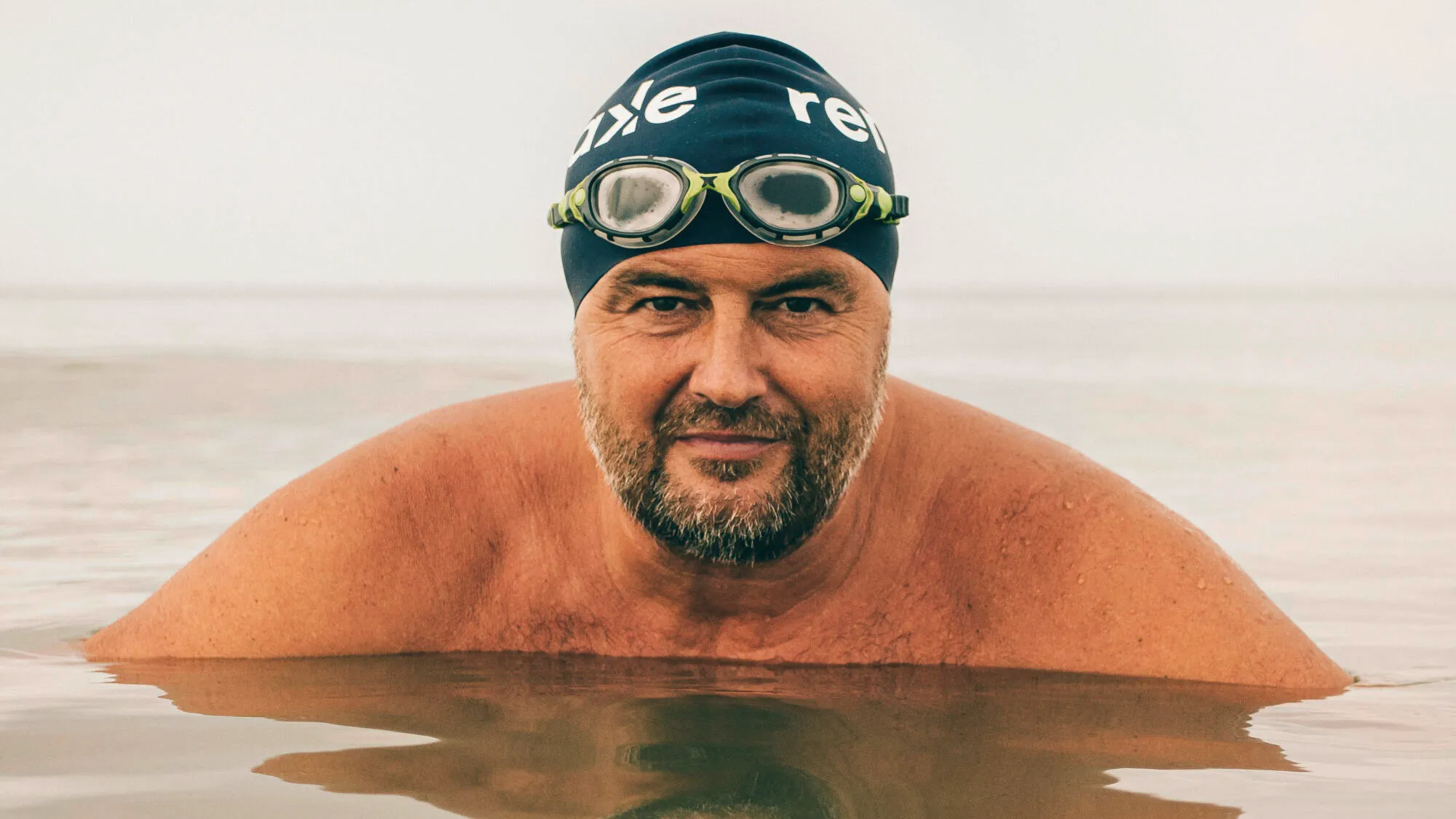
“Stève the seal”: “When I lost everything, the sea called me”
In April 2026, you crossed the Rio de la Plata, between Argentina and Uruguay: 43 km covered in almost eighteen hours. What are we thinking about all this time?
I’m working ! In my head, it’s like a library with filing cabinets. For an hour, I will think about an artistic project. Then, after refueling, I will imagine myself running down the Champs-Élysées. I save quarters of an hour like that. And above all, time does not flow at the same speed in water.
Is getting back to dry land complicated?
The return to reality can be violent. I’m still earth-sick. Because what I experience in the water is incredible. When I swim, nothing interferes with this connection to nature. We talk a lot about the man of records, but for me, it is above all an inner journey.
I’m going to look for sensations that I don’t have access to on a daily basis. I find my intuitions, all my senses are awake, I feel deeply alive. My body becomes a barometer. Even after fifty-one hours of swimming, despite the blows, despite this grouper mouth that I find myself with because of the salt, once out of the water, I only want one thing: to return to this state.
We meet in Wimereux (Pas-de-Calais), not far from Cap Gris-Nez, where your grandfather took you as a child to watch the Channel swimmers…
He lived in Sangatte, where departures took place at the time. All my childhood, I was a spectator of this crossing. I saw swimmers slathering themselves in grease in restaurants just before leaving one country for another. It has always fascinated me.
But as I wasn’t a swimmer, I forbade myself from dreaming about it. Until the day it becomes the challenge of your life… In 2017, I experienced a painful separation. I lost my job, my house, and no longer saw my children. For a year I slept in a shed that I almost couldn’t afford at the end.
I was in a state of great vulnerability, to the point of asking myself: “What would you like to do one last time here on Earth?” » Then one day, my little inner voice told me: “Take a swimsuit, some glasses and go to the beach with your dog. » It was a call.
I went to Pointe aux Oies, north of Wimereux. The light was very beautiful. I got on my back in the water and everything cleared up. I said to myself: “You are 40 years old and nothing left to lose. You don’t care about how others look at you, start from scratch. »
It was at that moment that my childhood dream became the challenge of my life: to swim across the English Channel. I sold my last belongings, including cycling equipment, to a gentleman from Wimereux – whom I met again by chance recently. It was thanks to him that I bought my ferry ticket to England.
You were far from imagining that this crossing would turn your life upside down…
I just wanted to cross the Channel and bounce back! But there, I met Kevin Murphy, a cold water swimming legend, who became a coach after his career. When I knocked on his door, he said to me: “I see the distress and determination in your eyes, give me five (“Tope-la!”, in French). »
And the adventure begins. But I quickly understand that I am not up to weight: I weigh 63 kg. To swim without a wetsuit in cold water, you need natural protection. I see the English swimmers gobbling up sweets and cakes, but I have a hard time with sugar.
I then took inspiration from the diet of an animal that I studied when I was younger: the seal. I started eating only fatty fish: herring, mackerel, sardines… At first, everyone thought I was crazy. By constantly giving me fish at the aid stations, Kevin nicknamed me “Stève the seal” – “the seal” in French.
Where does this attraction to seals come from?
I grew up in the Bay of Somme, which is home to large colonies of seal calves and gray seals. On weekends, I was allowed to borrow my father’s equipment to photograph them. One day, while kayaking with friends, I saw a seal in the tall grass.
I must have been 13 at the time. It was a revelation. I came back the next day to photograph him, but he was no longer there. While looking for it, I met members of the Picardie Nature association. For a while, I identified seals for them with my photos. Today, at six feet tall and weighing a hundred kilos, I look a little like them.
“When I was 13, I saw a seal in the tall grass. It was a revelation. »
Stève Stievenart
For almost ten years, you have been in the water two to three times a day, every day, regardless of the weather. Can’t get enough?
No ! Some days, of course. Especially in winter. When the alarm goes off at 2 a.m., it’s zero degrees and the wind is blowing from the north. When you have to scrape the windshield before going to practice, you know it’s going to sting. But it is also these moments that serve me during difficult crossings.
I think about everything that was hard in training. Everything you are going to be confronted with must have been worked on beforehand: jellyfish, algae, temperature variations, surf, night swimming… There is a lot of night time in my crossings.
Isn’t that terrifying?
Before leaving, I always announce my intention, what I am coming to do in the immensity of this ocean. This is what helps me channel fear. I’m just a guest. The game is to constantly adapt to become one with it and never enter into opposition.
It’s a kind of humility: you have to accept that at times, the sea rejects you. Sometimes you arrive, you catch the first wave, you’re stuck at the bottom, you’ve lost your glasses… So, as we say at home, “you’re going home”, and tomorrow is another day.
Has open water swimming strengthened your connection with nature?
No, I’ve had it since I was little. I grew up in the countryside, near a wood. Being outside is a visceral need for me. Although I travel a lot, I deeply need to return here, to Wimereux, to my roots. To go to Pointe aux Oies and watch how a pebble is formed under the effect of erosion… I am above all a lover of life.
And the living makes you feel good, like during your last crossing, where a mother dolphin and her calf swam alongside you…
We looked at each other as I look at you there. What added magic to this interaction was that she took the initiative to come to me. And then everyone went their own way. It’s a look that changes a life.
Have you had any other equally striking experiences?
Between Ireland and Scotland, the North Channel (or North Channel) is a strait populated by lion’s mane jellyfish whose filaments can reach twenty meters long. Suffice to say that you are constantly touching them when you swim there.
I had been there for over ten hours and my heart rate was racing from the toxin released by their bites. I was going to have to get back on the boat. So I asked for help. And there, the tide turned. The school of jellyfish opened like a theater curtain, the way was clear.
I felt myself being pushed by the swell, I was almost surfing. Then a first dolphin passed near me, a second… I found myself escorted by twelve dolphins. My team never recovered.
“Between Ireland and Scotland, the Northern Canal is populated with jellyfish. I was escorted by twelve dolphins. »
Stève Stievenart
Do you feel like you’ve had two lives?
There are pieces of my previous life that still serve me today, especially in sport. When I was jetskiing, you always had to look into the distance. This helps me when I swim. But my way of seeing things has profoundly changed.
Like many people, without being materialistic, I liked shiny things, beautiful cars, for example. Then I lost everything. And I understood that not owning anything makes you free. Today, the most important thing for me is to have time. This is where I place the cursor of my success. And time, when I swim, I have a lot of it.
The biography of Stève Stievenart
- May 7, 1977. Born in Abbeville (Somme).
- 2007. Participate in his first IronMan (triathlon).
- 2018. Departure for England and first crossing of the Channel.
- 2020. First Frenchman to successfully complete the “two-way”, the round-trip crossing of the Channel.
- 2023. First swimmer to successfully complete the “threeway”, three crossings between Catalina Island and Los Angeles (California). 120 km covered in fifty-one hours and eighteen minutes.
- 2024. First to complete the Ice Sevens over a year: 1.6 km on each continent in water between 0 and 5°C.
- 2026. First swimmer to complete the “triple crown at the end of the world”: crossing the Beagle Strait (between Argentina and Chile), that of Magellan (Chile), and the Rio de la Plata.


