Toulouse celebrates the colorful world of Castelbajac
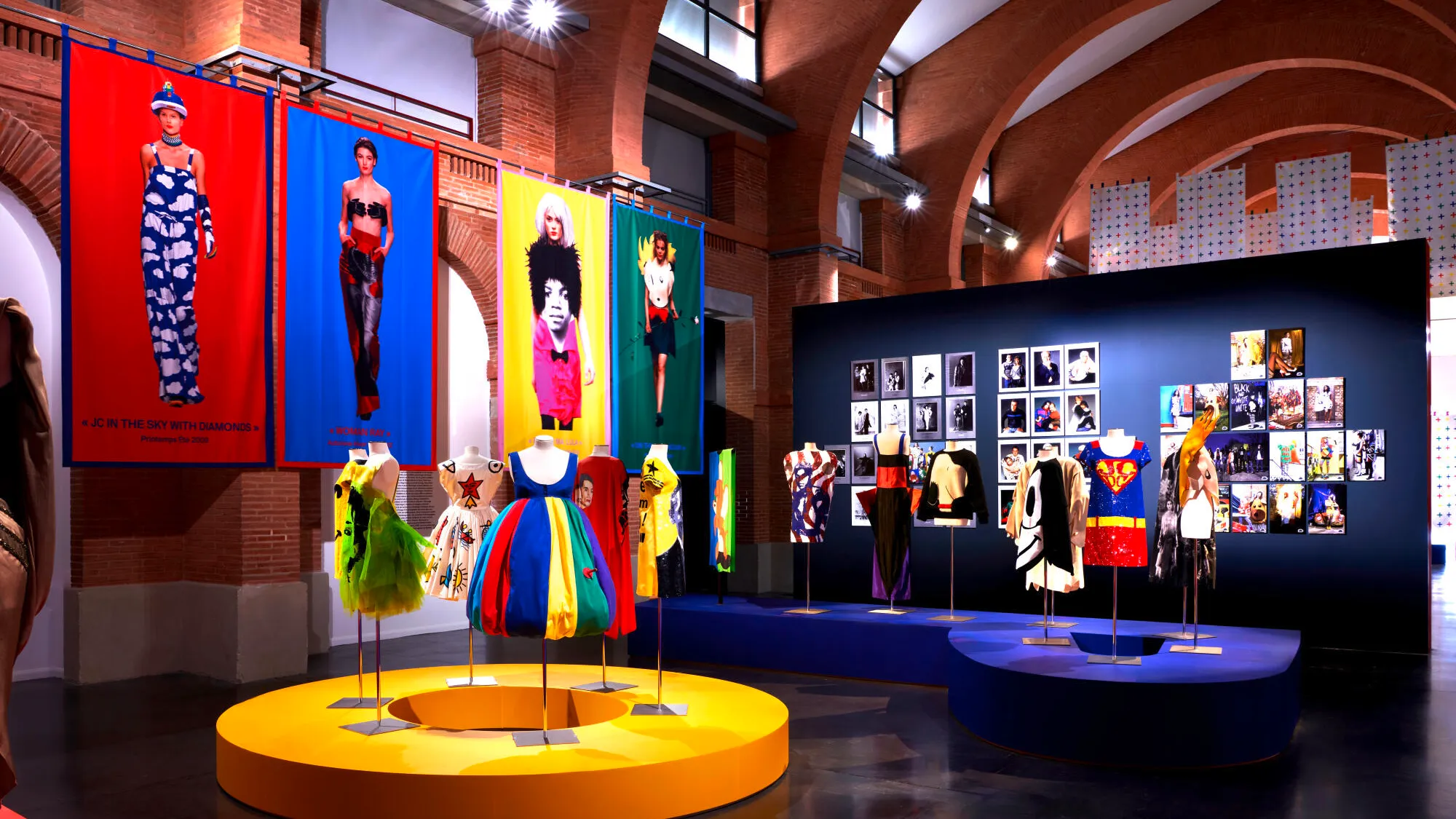
From the first room, we understand that this visit is going to be joyful. Yellow, blue, red, the hanging banners which welcome the visitor set the tone. We recognize the colors dear to the artist.
It all started at the end of the 1960s when Jean-Charles de Castelbajac created a coat from his boarding school blanket. He will then use other poor materials, such as cardboard or mop, before designing clothes that combine utility and creativity such as the K-Way two-seater poncho. Passionate about literature and poetry, the young man began composing “dress poems” in 1981 using his own words and those of famous authors such as Jean Cocteau. During this same period, in reaction to the consumer society, he appropriated everyday objects to make clothes: stuffed animals, gloves, sweaters… like the famous “teddy bear coat” (See photo 1 below). “Clothing sculptures” which are so many refuges and accumulations of tenderness, as the artist confides, which we can listen to throughout the course.
Colors, sequins, patterns and rhinestones
The most spectacular room is that of the large vault under which he exhibits his “portrait dresses” (See photo 2 below). We recognize Mohamed Ali, Marilyn Monroe, Barack Obama, but also other icons of the 20th century, these graphic ones, like smileys. Here, everything is colors, patterns, materials and rhinestones, to celebrate pop culture. On the wall, a series of photographs pays homage to the artists wearing his creations, such as Andy Warhol. For the couturier, who describes himself as “undisciplined”, fashion, photography and cinema create bridges. This is evidenced by his “painting dresses”: against a blue, then yellow, wall background, we can admire a “museum coat”, a jacket representing Van Gogh’s room, or a dress by Ben. The designer, who also worked with Courrèges, “likes this idea of community, creating and inventing things together”.
Always guided by the colors blue, red and yellow, Jean-Charles de Castelbajac continues his work by imagining liturgical vestments. It is in a room that he wanted as a chapel that we can admire the chasuble created for a prison chaplain in 1987 and that of Pope John Paul II for WYD in Paris in 1997. In 2024, he designed the liturgical vestments for the reopening of Notre-Dame de Paris.
To talk about himself, Jean-Charles de Castelbajac uses the words of Jean Cocteau: “I am a jack of all trades, because everything affects me. » His inspiration is indeed insatiable. As we leave this place, we say to ourselves: “When will we see the next part? »