“We crave relationships that matter”
As a teenager, you rubbed shoulders with marginality. That’s to say ?
At 17, I left my parents’ house, without knowing where I was going. I no longer worked at school, my life was focused on friends and music. It was the time of utopian communities, the beginning of drugs… I lived with people on the street. I remember collecting food at the end of the markets, or only having to eat dandelions that I picked in the fields.
What did you miss in your family?
Truth be told, I had everything I needed: a family as loving as possible, parents who wanted to offer complete freedom to their children. What I lacked was in building myself.
I was a “floating individual.” By rebelling, I only put into practice what my father said: “Be in the invention, don’t follow the framework. Seek your paths, be unique, creative. » Except that in reality, no one stands up from the inside without a relationship. No one finds the path of their life without confirmation of their existence in the eyes of others.
Basically, when leaving, as in all the commitments of my life, I believe that I was looking for my place in a living companionship.
How did you get out of wandering?
The experience of utopian communities brought me back to a common reality: we cannot just “be”; we must act, do.
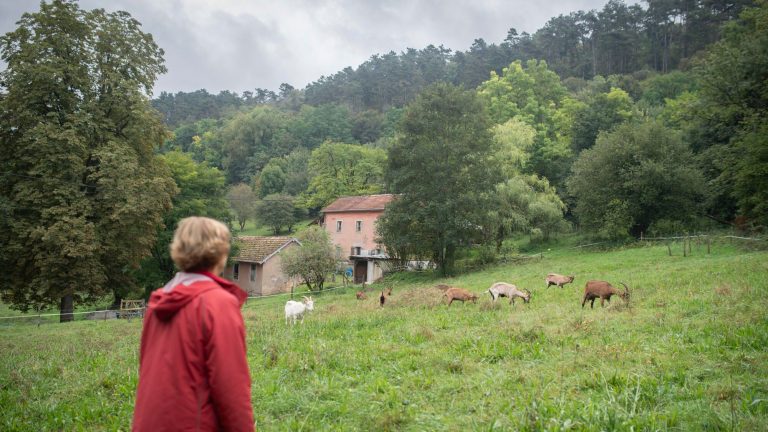
I worked for a few months with an old farmer in Lot-et-Garonne. He made his wine, his duck confit, his vegetable garden… From him, I learned a thousand things and wanted to be a farmer.
Did the experiment end?
I lived for about a year self-sufficiently on a family property, cultivating my vegetable garden and raising a few animals. Living alone, I looked at the path to the house for long moments, hoping to see someone coming. What if I brought a girl into this field? Very young, I drew and made music. I enrolled in a Parisian art workshop, with the idea of meeting people of the same sensitivity as me. I imagined myself with a woman artist.
Your experience of life in a sensitive city, then in a rural hamlet, led you to title your book Relationships that matter. What is it about?
I want to talk about relationships of authentic presence, personal relationships, truly reciprocal. And it is the most vulnerable who help us get there, because they show us, in an extremely effective way, that our relationships are made up of implicit contracts of social recognition that hold us in roles.
But in the face of the one who suffers, in the face of murdered innocence, something trembles deep in our soul and frees us from these shackles. We then touch on this common fund of humanity which connects us to each other.
What do you think these authentic relationships bring?
Whoever we are, our solitudes are inhabited by a relationship with ourselves which is embedded in a relationship with the world and with others: there is the impulse of presence which makes us alive. Believers will speak of a transcendent presence that appears within oneself, but, believers or not, we all know that the meaning of our lives depends on our attachments to those we love and who love us. Relationships that matter are therefore at the heart of our lives: they open the way to self-construction and self-assurance.
Moreover, the appeal of social networks is proof of this: it shows to what extent the thirst to be recognized by others is vital. Everyone is looking for “likes”, approvals, invitations to be able to say “I matter”. But without the assurance that real relationships provide, we remain in a continual search for self-confirmation from others. And at the mercy of the one who no longer judges himself, who will never recognize any error and calls us to allegiance, as we see in the person of Trump. The news is disturbing.
You also encountered violence in the Cité de l’Étoile, in Bobigny (Seine-Saint-Denis)…
I discovered this city when I chose to join the social landlord Emmaüs habitat. I worked there as a building employee: I washed the corridors, took out the trash, then I became a caretaker. In seven years, I have visited all the apartments and met all the residents of the city! Many of them found themselves in great precariousness. And there was drug trafficking.
It was very complicated, because the majority of residents in this neighborhood had close neighborly relations: people greeted each other there like in a village, but they were prisoners of their relegation. So, in each building, we put in place a delegate, a person who liaised with the tenants and the caretaker. Suddenly, people could meet at the foot of their building, have a coffee together and chat. I organized meetings from time to time. We had street meals and supported lots of community activities that allowed us to build interpersonal relationships.
For what result?
These links allowed residents to feel part of a neighborhood community of mutual aid.
I realized their powerful effect. If they were strong and diversified, it became more difficult for traffickers to maintain control of the halls, more difficult for a neighbor to show aggression.
Isolation leads to fear. What is missing is not more police – they cannot be there all the time – or more convictions in court, even if both justice and police are necessary. What’s missing is more links. I understood that democracy is based on this ability of citizens to experience close relational commitments with each other. What we can also call the republican fraternity.