what weight for Vatican diplomacy today?
The good of the beloved Venezuelan people must prevail over all other considerations and lead to overcoming violence (…), guaranteeing the sovereignty of the country. This exhortation from Pope Leo XIV, the day after the American military intervention in Caracas, which led to the capture of President Nicolas Maduro, is emblematic of the style of diplomacy of the smallest state in the world.
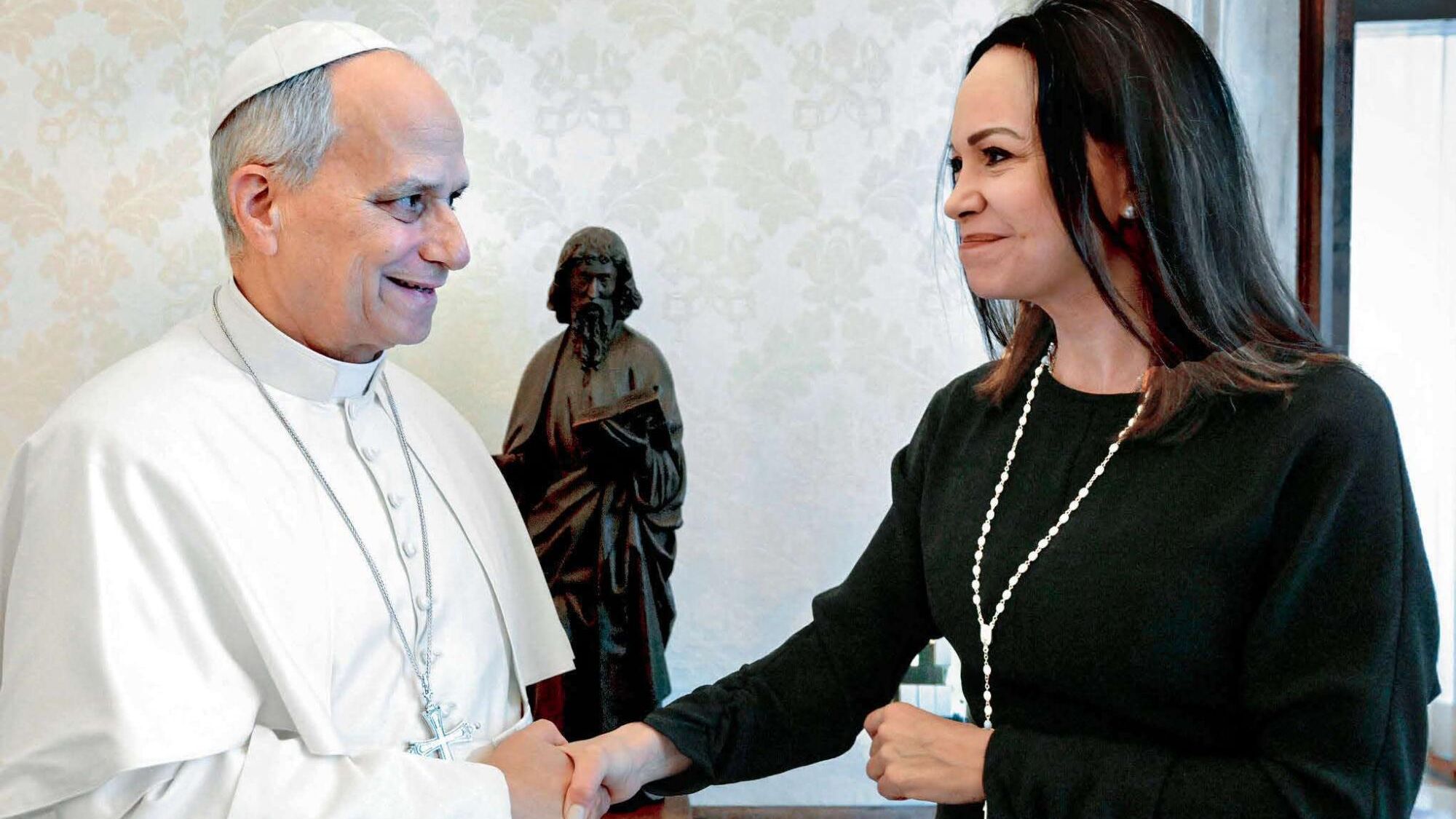
From the window of the apostolic palace where he recites the Sunday Angelus, the pontiff does not designate any protagonist. He calls for respect for the rule of law, with caution. And he confides his “deep concern”: because Peter’s successor is not a head of state like any other. The role of the pope, beyond partisan interests, is to “propose better understanding between countries”, the Vatican insists. And as pastor, to embody the concern for the Gospel for all people.
The crowd is dense in Saint Peter’s Square to listen to the Bishop of Rome. But his words seem to fall into a geopolitical void. For ten years, however, the Holy See has invested and attempted to exert its influence through discreet channels of dialogue around the Venezuelan powder keg.
Moreover, before Christmas, according to Washington Post Cardinal Secretary of State Pietro Parolin, a sort of “Prime Minister”, would have suggested to the Americans to accept an exfiltration of Nicolas Maduro to Moscow. While the Vatican regretted “that elements of a confidential conversation were disclosed in a manner that does not faithfully reflect its content,” it did not, however, deny the information from the American newspaper. Rome’s efforts were wasted effort: the planet entered the year 2026 as a spectator of this international “coup d’état”.
The strength of a network
Ultimately, in a world dominated by great powers like the United States, Russia and China, does the weight of the microstate really matter? For Romilda Ferrauto, who long directed the French section of Vatican Radio, “the diplomacy of the Holy See, although different from others, remains influential.” Far from being defeatist, the expert, who collaborated for forty-five years with the Vatican under four pontificates, believes that at present, its actions “are more closely followed than in the past, because we are in a complex and polarized international framework, where politics often becomes illegible and indecipherable.” In this confusion, “the word of the pope can have an impact,” she assures. Its strength lies in particular in its network: the Holy See maintains diplomatic relations with 184 States, and has a network of apostolic nuncios, the pope’s “ambassadors”. It also has the status of permanent observer state at the UN.
Certainly, the diplomacy of this sovereign micro-entity has “limits”, being unable to impose sanctions or have military forces, recognizes Romilda Ferrauto. During a press conference upon returning from his trip to Turkey and Lebanon last December, Leo XIV launched a discreet call for “economic pressure” on Venezuela, implicitly revealing the Vatican’s little room for maneuver.
Caution and measure
However, its lack of resources could also be its advantage. “The Holy See, because it is outside of political games, can be considered as a place of mediation,” adds the expert. Even though his offers rarely get a response. Last fall, Leo XIV’s proposal to host talks between Ukraine and Russia at the Vatican was rejected. “Choosing the capital of the Catholic Church as a place of negotiation between two Orthodox countries is not very realistic,” we recognize behind the scenes. Are we seeing any changes under the pontificate initiated eight months ago? “We notice a great prudence and a great measure, which can be linked in part to the personality of the pope, and to the explosive international situation”, breathes a Roman source.
Others, like an ambassador stationed in Rome, judge that “he is not a pope who hides behind banalities and he is not afraid to say things clearly”. Leo » According to this interlocutor, the American pontiff “has leverage over Maga Catholics (Make America Great Again, Donald Trump’s campaign slogan, editor’s note) » .
In Washington, the tone has also changed. Donald Trump, who was hardly sparing of Pope Francis, is more attentive to Leo XIV, aware of the attachment that many of his voters have for him. This impact is above all of the order of spiritual adherence. “There are Catholics all over the world. The faithful, who represent, one could say, “the nationals” of the Holy See, are much more present on the globe than those of any other country,” insists Romilda Ferrauto.
A long-term vision
At the Vatican, it is indicated that with Leo XIV, “the diplomatic line of the Holy See has not changed”. “The Secretary of State seeks to guarantee continuity,” it is said. The micro-state follows an immovable line of conduct which sometimes resembles a balancing act: maintaining a certain neutrality in conflicts, while maintaining dialogue with all parties involved. Despite criticism and misunderstanding, “this is the vocation of the Holy See and its destiny. We wish to be at the service of both parties,” one murmurs in the corridors of the apostolic palace, in particular with reference to the subject of the highly sensitive Israeli-Palestinian conflict, the repercussions of which are being felt as far away as Iran these days.
Many also note that the voice of the Vatican is part of the “long term”. This approach does not prevent it from reacting urgently: “Faced with massacres, the Holy See can act quickly, by sending emissaries or aid. Saving human lives is a priority. He can’t wait for the corpses to pile up,” says Romilda Ferrauto. From his first days, Leo XIV pledged to do “everything possible so that (the) peace spreads”. “The Church will not tire of repeating: let the weapons be silent,” he promised, like an oath.
Who are the nuncios?
Currently, the Holy See has 98 apostolic nuncios in office. Most of them trained in Rome, within the Ecclesiastical Academy shortly after their ordination, then sent to serve Vatican diplomacy throughout the world, these archbishops appointed by the Pope exercise a dual mission.
They have the rank of ambassadors: they represent the Holy See to the 184 states which maintain relations with the Vatican, and are also present with numerous international organizations, notably the European Union and the United Nations. The work of these papal diplomats is coordinated by the Secretariat of State, a central administration that also serves as the Ministry of Foreign Affairs. The nuncios also constitute an important link in the relations between the Bishop of Rome and the Roman Curia, on the one hand, and the dioceses of the Catholic Church in each country, on the other hand. They participate in particular in the process of selecting new bishops, who are appointed by the pope.
184
States maintain diplomatic relations with the Holy See.
Source: vaticannews. go


