
Festival Escale à Sète: the craze of maritime festivals
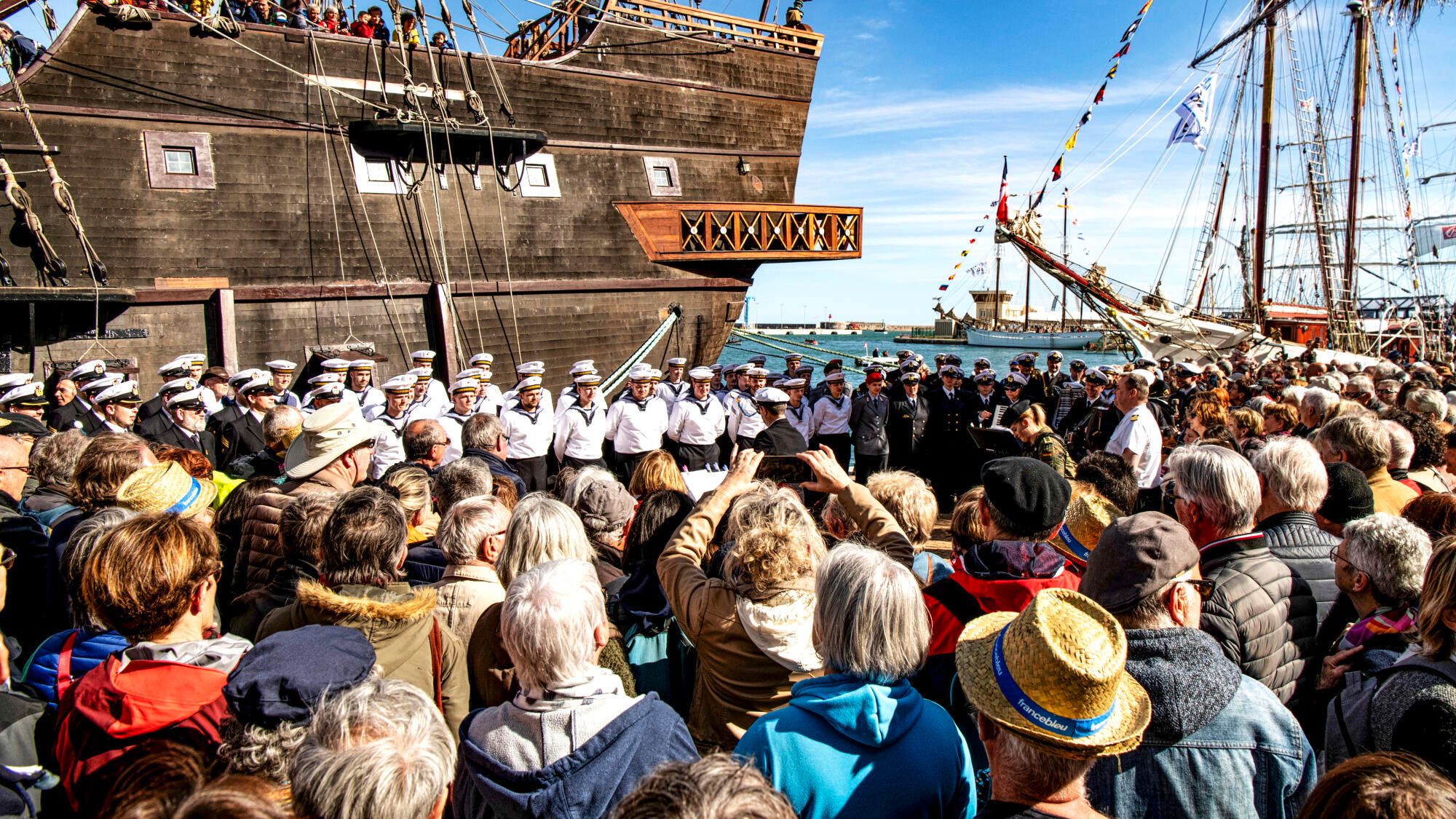
Like large white birds emerging from the Mediterranean, around a hundred sailboats will dock at the port of Sète (Hérault), Tuesday March 31, 2026, at the end of a dazzling parade. There will be the famous Belem, large French three-masted ship that became a training ship; at his side, the brig Phoenix initially intended for Danish evangelical missions, or the Portuguese schooner Santa Maria Manuela, built to fish for cod… Everyone will converge at the Escale à Sète festival where they are the stars.
During the week, the public will be able to visit them upon paid reservation. But also discover, without an entry fee, the numerous so-called “working” boats (and not pleasure boats) of all sizes. Rowing games and competitions will enliven the pools. On land, fans will admire the parade of crews, demonstrations of traditional know-how by blacksmiths and marine carpenters. They will listen to sea shanties or take part in workshops to learn how to tie ropes, in conferences on the future of the Mediterranean…
At least 300,000 visitors are expected for this event which transforms the city, every two years since 2010. A figure that is steadily increasing. “There is an incredible atmosphere at the port,” says Clément, 44, who has lived in the Hérault city for ten years. We meet people from all over the Mediterranean there, it’s fascinating. »
An invitation to travel
Other gatherings of old rigs take place at regular intervals in Western ports (read the box at the end of the article). Annick Fanon, 85 years old today, remembers very well the first Armada of Rouen, during the bicentenary of the Revolution, in 1989. “All these old boats, it was magnificent. Never seen before! »
It was marked by their parade on the Seine, when they, one behind the other, returned to Le Havre (Seine-Maritime): “We came as a family, with children and grandchildren. In the masts, there were sailors singing and greeting us as we passed. We have come back six times, but now there are too many crowds and less spontaneity. »
In 2023, in fact, the Armada brought together five million spectators, eager to admire 45 large sailing ships and take part in the free entertainment. “This is the largest French event on a single site,” insists its president, Jean-Paul Rivière. More modest and paying but significant, the Maritime Festivals of Brest (Finistère) brought together in 2024, 500,000 visitors and those of Douarnenez (Finistère), recorded 60,000 entries.
Everywhere on the coast, enthusiasm has been growing since in 1986, volunteers created the association which supports the Douarnenez maritime festivals, the very first gathering in France of old rigging. “They constitute an ingredient that speaks to our imagination, invites us to travel,” analyzes Camille Gontier, sociologist at the University of Western Brittany and president of the said association.
These sailboats from another age evoke in us pirate films, stories of exploration… “When I visited the replica of one of Christopher Columbus’ caravels, in Brest,” confirms Marie, 60, “I was surprised to see how fragile it seemed on the ocean. It was very moving to think that men had sailed on it for weeks, without even knowing what they were going to discover…”
These are the sailboats that discovered the world, and they carry many legends in their wake.
Olivier de Kersauson, navigator (born in 1944)
An industrial heritage to save
For Raymond Dublanc, co-president of Escale à Sète, beyond the dream, the challenge is to convey: “It’s up to us to discover the maritime heritage and culture that lies behind these sailboats. »
These different celebrations are supported by enthusiasts who campaign for “the preservation of gestures”, as Camille Gontier nicely puts it. For him, the movement was born from the decline of fishing and related activities. “Fishing boats are the Breton equivalent of the mines in the North or the steel industry in the East. It is an industrial heritage in danger, and the State is more interested in the valorization of former military ships. So, those who are attached to this story try to counter the disappearance of this link with the sea by sharing it with as many people as possible. »
At the same time, he observes the growing desire of local authorities to “create a tourist dynamic around a larger territory”. With, for example, Gulf Week, in Morbihan, where sailboats go from port to port.
In all cases, the role of associations and private patrons remains essential. “It is very costly in terms of money and time to maintain a wooden “heritage boat”, recognizes Laurence, 43, member of the Treizour association, with a social vocation, which introduces groups to old-fashioned navigation, in Douarnenez.
A good number of the ships, small or large, which sail from festival to festival are identically rebuilt replicas (but adapted to modern sailing conditions) or restored boats, transformed over the course of their history. Nevertheless, the associations insist on the authenticity of the sailboats and the know-how, a guarantee of the quality of these gatherings. Raymond Dublanc even had it included in the Escale à Sète charter “in the same way as the criteria of transmission, respect for the environment and solidarity”, he insists.
This solidarity between seafarers is found, according to him, in the commitment of hundreds of volunteers, many of whom began as spectators. Such as Clément who is now responsible for creating the furniture for the Escale stands in Sète, while Soufian, a 29-year-old business manager, finds the time to be the festival’s “Swiss army knife” and takes care of relations with partners all year round.
In Rouen (Seine-Maritime), Thierry, a volunteer from the start, is happy to have participated in the logistics of the Armada which “contributed to reviving the river and the quays of our city”. At 79, he handed over to a younger man whom he trained. But he is still busy organizing the sailors’ mass in 2027: “We have to find the right boat so that the faithful can see well and the cameras of the Lord’s Day can retransmit it,” he explains.
As in their association, “on a boat without an engine, the entire crew must work cohesively,” adds Laurence. It’s very educational for the young people or people with disabilities that we bring and, during these gatherings, there are a lot of exchanges. We maneuver and admire each other: we are both participants and audiences! »
For those who come looking for an escape, maritime festivals offer exceptional moments, real encounters and the sharing of knowledge. Enough to maintain the enthusiasm of the crowds for many editions.


