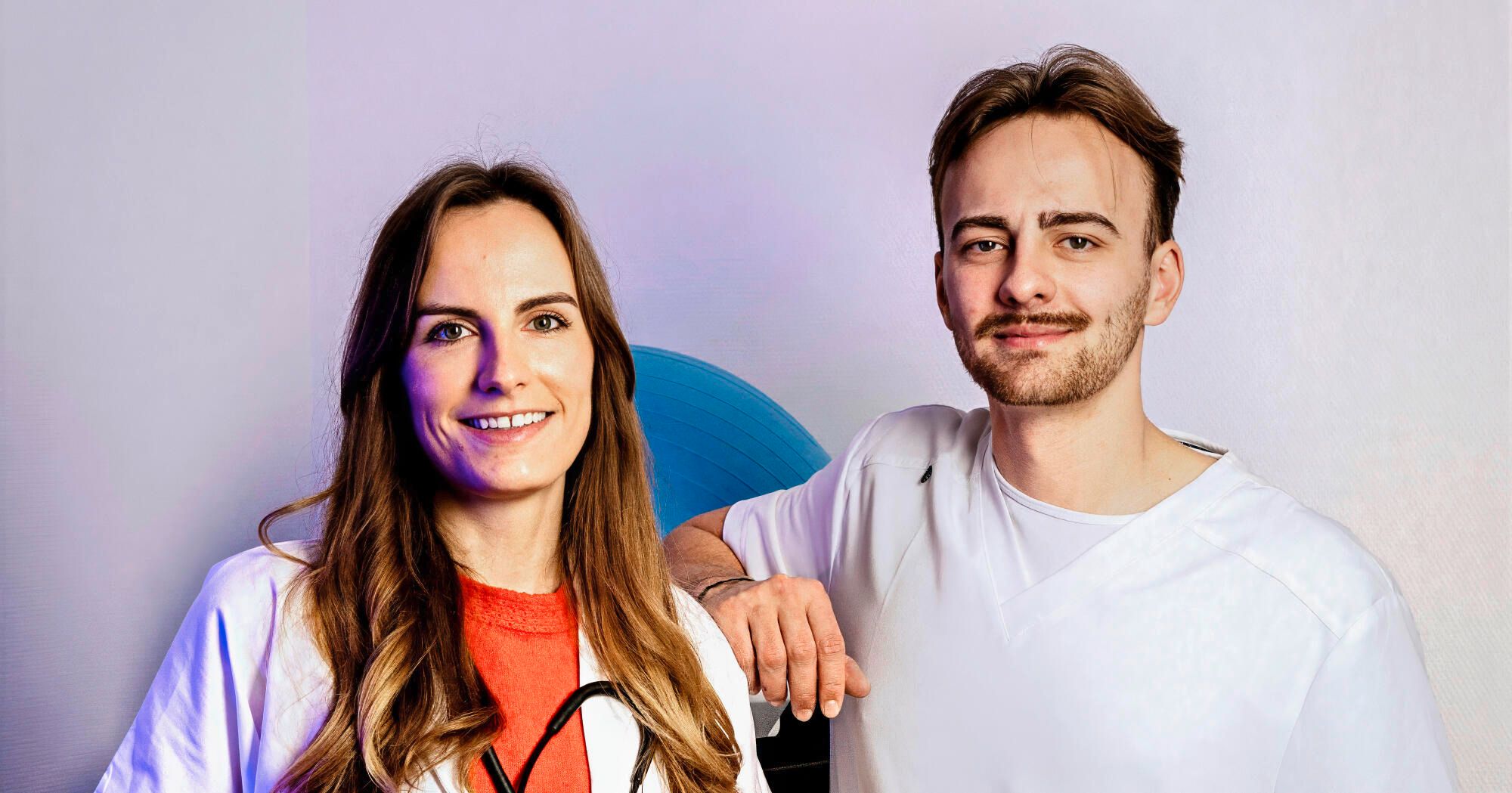
Two caregivers travel through medical deserts in France
How was your tour of France in the medical deserts decided?
Anaïs Werestchack: Setting up in a practice at the end of our studies did not seem reasonable to us: we did not have the financial means and not enough experience. We had the idea of going to do replacements for two or three weeks, for a year, in different regions (Alsace, Brittany, Normandy, Hauts-de-France, etc.). We wanted to understand from the inside what patients and caregivers were experiencing in these difficult areas and tell what statistics and political measures do not explain.
Brice Philippon: I am originally from Vichy (Allier) and Anaïs is from Beaumont, near Clermont-Ferrand (Puy-de-Dôme). Areas classified as “under-endowed” in medical professions. Access to care is therefore an issue that particularly concerns us. It made a lot of sense for us to go and help where there was the greatest need.
What surprised you?
AW: We all know that emergency departments are overflowing, or that doctors’ appointment times are measured in months or even years. But we discovered even more worrying situations. One patient had not seen a doctor for eleven years, another for months. When the diagnosis was made, their disease was very advanced… Pregnant women without pregnancy monitoring. In Aveyron, I was the only doctor in 652 km², that seems unthinkable!
BP: I had no idea how difficult it is for caregivers. They work at a breakneck pace and cannot find substitutes. 75% of general practitioners would not be able to get a replacement in the summer, which represents 40 million consultations not carried out. One of the physiotherapists I replaced had only taken one week of vacation in eight years! This is not seen in any other profession.
And in patients?
AW: In these areas, real medicine is practiced, far from “bobology”. The vast majority of patients were incredibly kind and grateful. In rural areas, we measured how much they had understood the lack of health professionals and did not want to bother the doctor for nothing. It’s so difficult to find an appointment that they don’t want to go “for a runny nose” or a “little boo-boo.”
As a result, they often arrive hypertensive, off treatment for a long time or, due to a lack of specialists, with several serious pathologies. There, we often practice emergency medicine and, sometimes even, war medicine…
What did you learn there?
AW: We were confronted with a very human reality: patients arrive with their whole history, their whole life; we know their family, they confide more easily. This reinforced our belief that medicine is, above all, about human connections. There we met the one we want to practice, with strong and trusting relationships. A “country medicine”. In other words, we have the feeling of having learned more in one year than in ten years of study!
Where does your vocation as a caregiver come from?
BP: I have played a lot of sport for a long time, particularly rugby, and I have always admired the ability of the human body to adapt, to regenerate, to heal itself: being a physiotherapist is great for understanding all that.
AW: My mother is a nurse, my father always insisted that a career be meaningful. I wanted to work in a profession that would make me want to get up every morning, even if it was difficult. Ever since I was little, I wanted to be a doctor to help others. I loved going to my pediatrician, playing with the ophthalmologist’s instruments… While he was very ill, my grandfather was saved by brilliant doctors. In my childhood eyes, it was magical: some people knew how to prolong people’s lives. What a marvel!
Anaïs, your time in the world of Miss – you were elected Miss Auvergne in 2021 – hasn’t turned you away from it?
AW: No way ! I stayed locked away for ten months studying, stopwatch in hand. I entered these competitions for a change of scenery and to carry health messages for research against pediatric cancers or blood donation.
At the end of this Tour de France, are you discouraged?
AW: On the contrary. Even if the overall situation of the healthcare system is gloomy, we remain optimistic. We must not overshadow everything: there were difficult moments, but also very strong moments. We often speak with Brice in the evening when we get together after a day, even if it has been hard. An elderly person who smiles again, a woman who tells us that she is pregnant even though she has been trying to have a child for a long time, a cancer patient who goes into remission… These little moments galvanize us. When patients say “Thank you, Doctor” or “Good luck”, it’s the greatest reward.
Do you have any suggestions to make to improve the system?
AW: We have observed that some regions are doing better than others. They are also isolated and lack resources, but show more inventiveness. It now seems obvious to us that doctors must work in groups – or with other medical or paramedical professions – within health homes or centers. This allows for discussion, support, improvement of practices, replacement, and referral to other professionals. Together, we are stronger.
BP: It is also necessary to rethink the distribution of missions within firms. A very significant part of our work is taken up by administrative tasks. Deploying medical assistants and specialized nurses allows more time to be spent with patients.
Do patients have a role to play?
AW: Of course ! We believe our system is at a tipping point and patients must now fully engage. They can help doctors by being more active during consultations: knowing their medications, their allergies, bringing their tests, questioning the practitioner, understanding their illness… Patients and caregivers, we must work together to move the system forward.
National Education must also teach the basics of health, so that patients do not come in the slightest doubt, due to lack of having the keys to assess the seriousness of a situation. This learning is a collective issue.
Just like prevention?
AW: Absolutely. The French are the Europeans who follow screening campaigns the least. But getting vaccinated and tested saves lives and helps Social Security. Because pathologies are thus identified earlier and remain lighter. It’s a benefit for everyone.
Is the creation of a fourth year of study for general medicine students, which encourages them to carry out their internships in under-resourced areas, a solution?
AW: Rather than extending the internship in this way, young graduates could be encouraged to spend several weeks or months in under-resourced areas throughout their course. Only experience in the field will make it possible to attract future doctors and to counter certain preconceived ideas. We must show them how many human and professional assets these territories contain.
Are you practicing today in a medical desert?
BP: Yes, I chose to settle in a small town in Allier, while Anaïs does replacements in a rural area near Vichy. For us, it’s about being consistent. The word “desert” suggests a large plain with nothing at all, but many places turned out to be paradise. Our tour of France also taught us that each day brings its share of hopes and little lights, we just have to learn to spot them and remember them.