
the French are taking the turn
Driving his electric car in the streets of Strasbourg (Bas-Rhin), Elies Anane still seems to have difficulty realizing. “I would have been asked the question two years ago, I would never have imagined buying one. For me, it was a gimmick. » The music teacher, however, took the plunge in 2025, pushed by his partner’s daily journeys. “She has to do 80 km round trip, and gasoline has become too expensive,” he admits behind the wheel of his Chinese BYD.
Like him, more and more French people are letting themselves be tempted. The war in Iran and the surge in prices at the pump have finally convinced many hesitants. Sales jumped 48% during the first four months of 2026 in France, even as the overall automobile market declines. In total, 148,302 electric vehicles found buyers, from small city cars to family models.
For many motorists, electric is no longer primarily an ecological choice, but an economic calculation. According to an Ipsos study, 46% of French people mention fuel savings first, compared to 35% environmental considerations. With her daily journeys, Elies’s partner Anane should save more than 10,000 euros over five years, to which are added lower maintenance costs.
The price remains a barrier
A long-term saving, which nevertheless requires a substantial initial investment. In the affluent Strasbourg European district of Contades, David Sandona and his wife have been wondering for several months. They already have a small electric Fiat 500 for urban trips, but switching to electric for the main car still seems difficult to them. “Models with good autonomy remain very expensive: we quickly reach more than 60,000 euros,” sighs the fifty-year-old. The couple first considered purchasing an electric Alfa Romeo, from the Stellantis group. “But we read that there were certain reliability concerns,” admits David. He finally opted for a hybrid. But the recent surge in fuel prices since the war in Iran enrages him. “If I had known that prices would rise so much, I would have taken the risk anyway. » Its full price went from 54 to 96 euros in four months.
In the Lille region, when Pauline Dandre comes home from work, a characteristic whistling sound betrays her engine. If she took the plunge, it was because she was convinced by the attractive price of an electric Volvo XC40 back from leasing. “It was about a year old, had very few kilometers and had been very well maintained,” says the mother of three boys. Two years later, there is no question of her returning to a thermal. “When we make a trip of 100 km or less, now we take mine,” explains Pauline. I only see positive things every day. I’ve never had a breakdown, I charge at home and, at worst, there are terminals. » His eldest son, aged 11, even tries to convert his grandparents, who are still attached to their diesel.
Like David Sandona, many motorists see the price of models capable of swallowing kilometers as the main obstacle, because before leaving Alsace for Brittany or the Dordogne for the holidays, the long charging breaks on the motorway are worrying.
“Until recently, manufacturers mainly sold electric cars to meet CO2 reduction objectives,” explains Nicolas Meilhan, an engineer specializing in the sector. This did not favor affordable models. » The market is now evolving rapidly, driven by the massive emergence of Chinese manufacturers like BYD or Xpeng, who are flooding the market by slashing prices, while offering premium finishing qualities. “BYD sells in a month what the Renault-Nissan-Mitsubishi alliance sells in a year,” summarizes Nicolas Meilhan. In the Strasbourg BYD dealership, while the salespeople are busy presenting the models to the ever-increasing number of customers, director Sébastien Bellini notices the change. “We didn’t go from nothing to everything,” he assures us. But a turn is being taken. »
The other part of this shift is the development of a second-hand market, which benefits from a particularity of electric vehicles. Nearly a quarter of these cars are acquired via long-term rental (LLD), leasing. While this also concerns individuals, business fleets mainly use this solution. Once these contracts are completed, these vehicles are available for second hand. A real challenge for manufacturers, who must sell this used fleet.
Densified terminal network
This positive feeling from users is well documented. According to a 2024 Ipsos survey, 93% of electric car owners are satisfied. Enough to fuel word of mouth and break down what industry players describe as “psychological brakes”. One of them concerns the density of charging stations.
In the center of Strasbourg, a Total Énergies service station no longer offers a choice between diesel or SP 98. From now on, you have to decide between 150 or 300 kWh, in the first 100% electric station in Alsace, inaugurated in June 2025. While an “electromobilist” hangs up the charging gun, a disoriented driver calls out to him: “But where do we find gasoline now? »
France has densified its network of terminals. In April 2026, the Ministry of Ecological Transition and Avere-France estimated their number at 194,9963. It has more than doubled in two years. By 2030, it should be increased to 400,000. According to the ministry, if we add individual installations, the total of charging points in France exceeds 2.95 million.
But this influx and the prospect of “full tanks” for a few euros are not entirely enough to conquer the hearts of certain car enthusiasts, for whom driving rhymes with pleasure. In their large apartment, Jean-Philippe Lustig and Amélie Sarbacher discuss their next car. From their east-facing balcony, the radiologist and the dental surgeon can see the Black Forest of neighboring Baden-Württemberg, birthplace of Porsche and the internal combustion engine. “I never thought I would consider getting an electric car,” admits the thirty-year-old, owner of an Audi A5. Amélie seems the most determined. “It will be electric. It doesn’t make any noise, it’s nice when you’re in it. » Jean-Philippe, for his part, wants to continue to see it above all as a solution for the second car in the household. But he is no longer so categorical. On his phone, he scrolls through the models spotted, the prices for recharging at the parking terminal of their recent building, the tax advantages surrounding this potential purchase… What could especially tip this car enthusiast over the edge is the emergence of pleasure, sporty models. “The Zeekr 7GT is a Chinese premium version: I say to myself, why not go for a model like that. »
This pleasure of driving powerful cars, even electric, Geoffroy Liégey discovered it in 2019. In front of his house, this trail enthusiast now plugs directly into a conventional socket. When he took the plunge seven years ago, he was a pioneer. Today, he doesn’t see himself going back. “Where I live, there are no gas stations and I have forgotten what it means to fill up,” he says. “Once you’ve gained that time, you don’t want to lose it again. »
Unequal to recharging
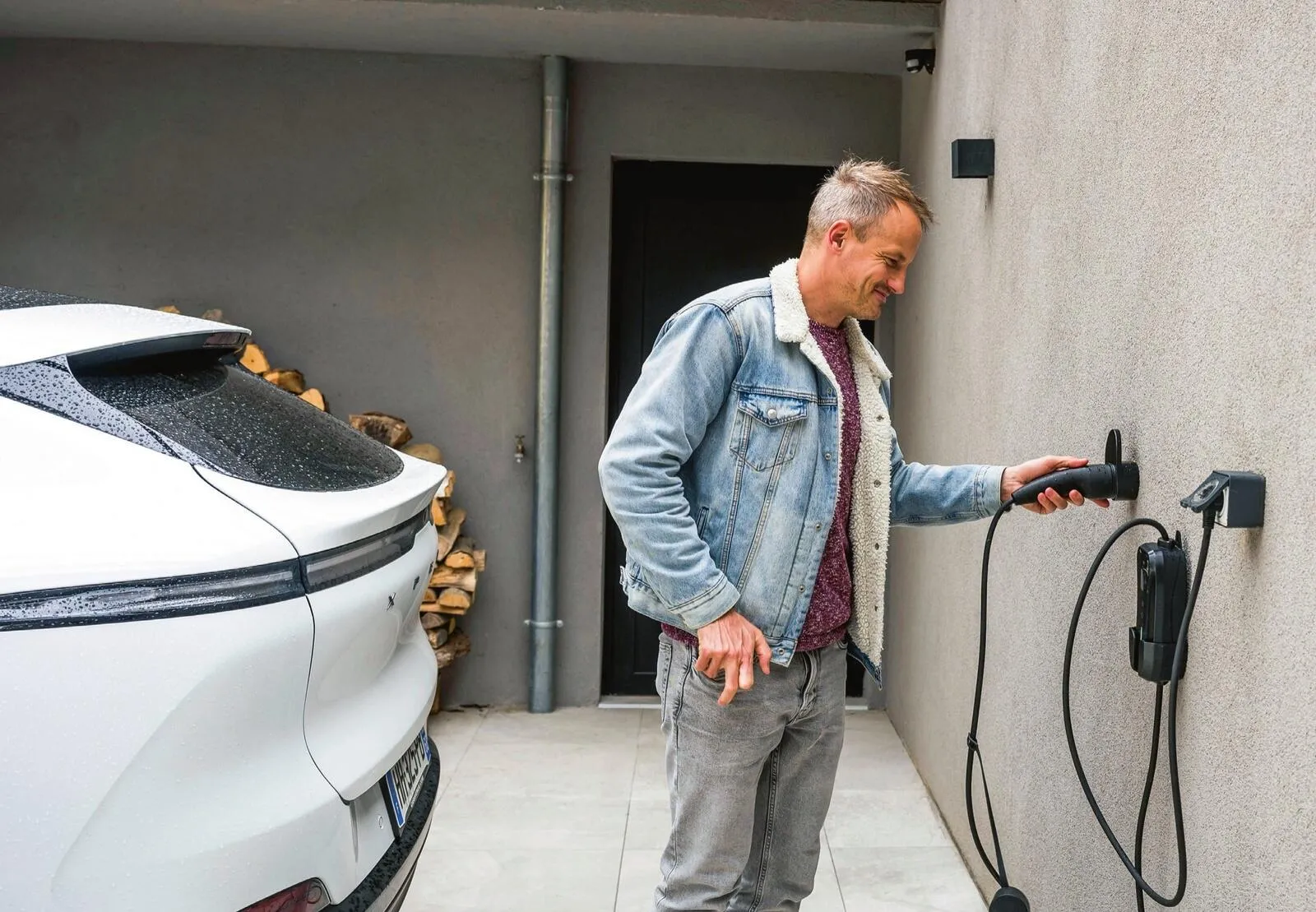
The road seems clear for electric, but this shift remains simpler to negotiate for the wealthiest households. Because beyond the price of cars, home charging changes everything. According to Enedis, 86% of electric car charging is done at home today. However, 42% of French people do not own their main residence and only 6% of collective buildings have a charging infrastructure. Companies will therefore be required to play a crucial role in allowing their employees to connect to their workplace.
Between the price of models offering good autonomy, the sometimes complex installation of a terminal or the need to have a garage, not all motorists leave with the same advantages. In co-ownerships, procedures can quickly become a headache. It took Elies Anane a year to have a terminal installed, by taking out a specific subscription.
The market is also supported by various national and European aids, which can reach up to 7,700 euros or social leasing at a maximum of 200 euros per month. The challenge will be to know if this sector is mature enough to maintain itself, once this aid disappears. Among manufacturers, there is no doubt: Renault intends to complete its electric transformation by 2030, with the launch of 36 models. The current is going well.
Prices not so well limited
At charging stations, pricing is unclear. At the same terminal, two “electric motorists” can pay two different prices for the same service. Not always easy to find your way around. There are several terminal operators: TotalÉnergies, Ionity, Electra, etc. They set prices, sell electricity directly and their subscriptions are used to retain drivers with reduced rates. But to allow users to pay reduced rates without having to take out a subscription with each operator, intermediaries (Chargemap, Shell Recharge, etc.) have appeared. They allow access to multiple networks with a single card or application and sometimes charge a commission or apply their own rates.
By the numbers
23.8% of new cars sold in France in February 2026 were 100% electric. Source: Avere-France.
400,000 Public charging stations should cover the territory by 2030. Source: Ministry of Ecological Transition.