
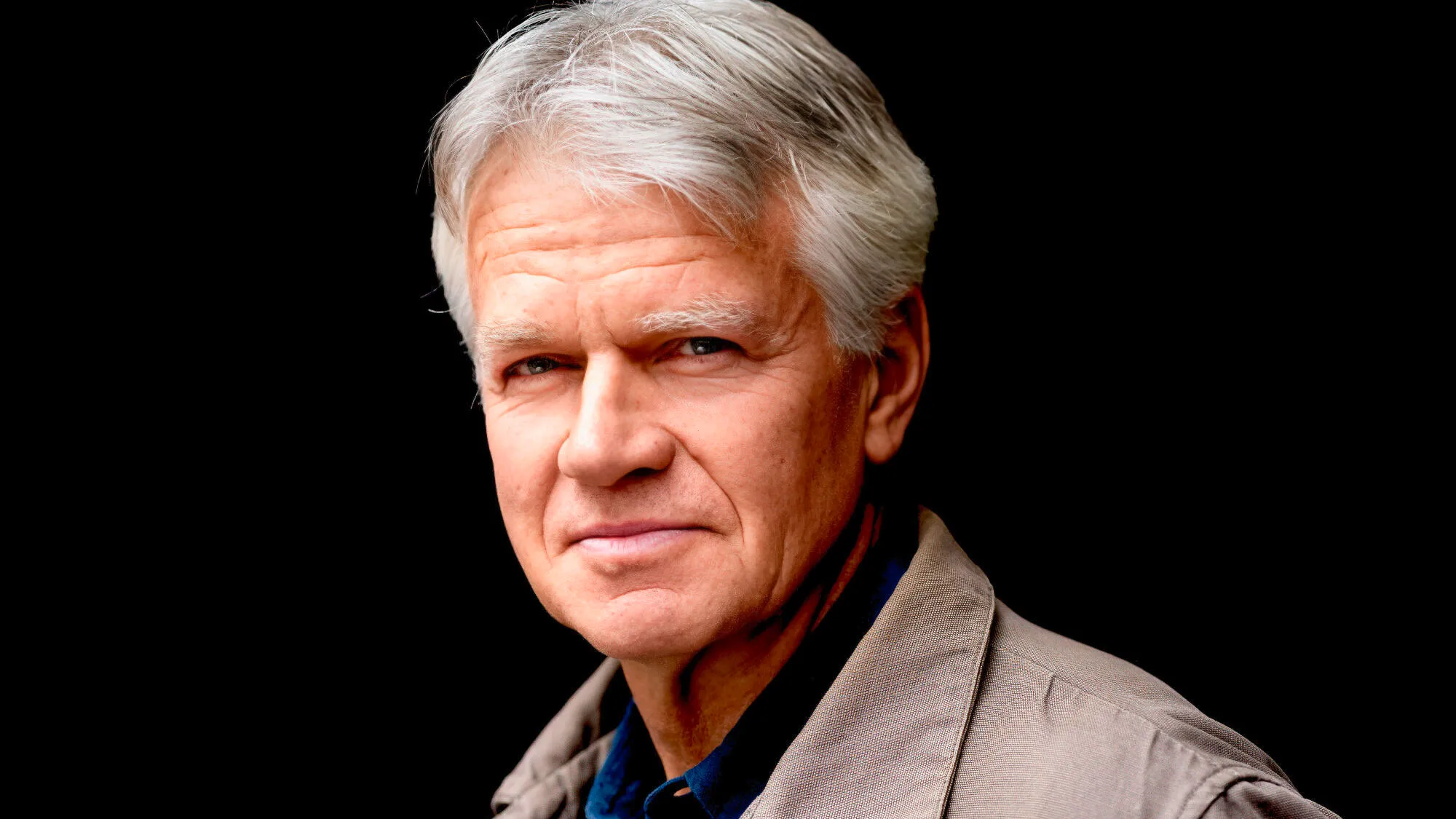
Olivier Weber publishes “Angels and Ogres”
Our meeting takes place just before your departure for Ukraine. Less present on the screens, this war continues. What are you going to do there?
I will open a humanitarian mission as president of Douleurs sans frontières, an NGO which trains professionals in pain management and psychological support. I will also go see acquaintances.
When Russia started the war, in February 2022, I was on the other side of the world, with Commander Massoud’s son, and I came back immediately: I rented a car and went to Zaporizhia and Kharkiv. It was Dantesque! When the Berlin Wall fell, I traveled the former Eastern European countries and wrote Journey to the land of all Russia.
The Ukrainians’ fight for freedom of opinion and expression is close to my heart. This population, especially its youth, understood that if it did not resist, the Russian steamroller would carry it away. Today she is holding on, but her men are exhausted…
You were a war reporter for twenty-five years. In China, in Eritrea, in Yemen, and of course in Afghanistan… How do we come back from this, psychologically?
Never unscathed… This is what we call post-war trauma syndrome. Soldiers and humanitarians benefit from therapies. We reporters must fend for ourselves. When I returned from Tiananmen Square in China, where I saw young people being massacred in the spring of 1989, I had nightmares for four months.
At 30, in Iraq, I hid with Kurdish peshmerga, in water up to my neck for three days, then in a collapsed house. That’s when a bullet grazed my ear. I denied it, speaking of it as a “lost bullet”. Later, when I realized that a sniper had targeted me, I put my emotion down on paper. Forty pages at once! Despite everything, I remain hopeful. I’m in a creative melancholy, because I write books: it’s certainly my way of getting out of it.
You are the president of the Joseph-Kessel prize, awarded each year at the Étonnants Voyageurs festival. What does it mean to you?
This prize rewards a documentary, adventure or travel story, in the tradition of the great writer. Florence Aubenas, Patrick Deville, Jean Rolin, Catherine Poulain were among the winners… This year, it is Nicolas Delesalle for The art of the ricochet, a funny, poetic book about a Moldovan journalist arrested without knowing why by the police, upon returning from a report in Ukraine.
For me, Joseph Kessel is a kind of big brother. Adventurer, great reporter, resistant, he denounced many injustices, notably violence against women in Beautiful day. Along with Joseph Conrad, Jack London, Cervantes, he is one of those writers that I discovered as a child and never left.
“I’m in a creative melancholy, because I write books: it’s certainly my way of getting out of it. »
Olivier Weber
What was your youth like?
I was in an orphanage, then in a boarding school, immersed in books. My mother, divorced and a fashion designer in Alsace, did everything she could to feed her three children – I have a sister and a little brother – but it wasn’t always possible.
I spent my childhood looking out towards the open sea in Nice, then towards the peaks, in the Roya valley where my mother later lived. I was even a shepherd at 14, which gave me plenty of time to read. I learned to talk to animals and rocks.
In a Franciscan monastery, a father took me under his wing. Her policeman side stopped me from doing stupid things… Then a beautiful and generous lady, named Marianne, offered me a scholarship to finance my studies. As I was passionate about the economy of developing countries, I studied economics, then international law in the United States, and a DEA in anthropology. All this to approach journalism…
Have you started a family?
I have a 34-year-old daughter, who works in cinema and advertising, and a 33-year-old son, an IT developer, who now lives very close to me.
You publish Angels and ogres, portraits of “lords or tappers” that you have met. It includes a fascinating woman nicknamed Commander Latifa. Who is she?
His name resonated in the Afghan maquis in the 1980s, when Commander Massoud’s mujahideen fought against the Soviets. I learned that it was a woman, a nurse who had by force of circumstances become a surgeon… Left for four months, she stayed for four years.
She is a formidable woman, one among all the angels we meet in areas of conflict, in the service of others, of humanity. Like Beaurecueil’s father, a Dominican speaking Arabic and Persian, who created an orphanage in Kabul.
Commander Latifa was part of Doctors Without Borders. While war is everywhere, we paradoxically no longer hear much about this organization…
We see them less because they are sometimes excluded from combat zones. Their status has also changed: there is less immunity for humanitarian officials, as well as for reporters. They have a financial value that allows them to be negotiated as hostages.
Fortunately, in the countries of the South, civil society has taken over. In Peru, Eritrea, Madagascar and South Africa, Médecins sans frontières and Médecins du monde, born in France, have spread. A myriad of local NGOs are doing incredible work on the ground to get children out of drugs and slavery and into education. It is on them that we can base our hope.
But we must not lose sight of the fact that these organizations are suffering. Not only are they mistreated by autocratic regimes because they promote human rights, but their funding is drying up. Until 2025, USAID (the United States Agency for International Development) donated more than $42 billion per year. This aid was cut by the Trump administration, endangering support programs, schools in Ukraine for example. Western countries are also reducing their funding.
In your book, you also portray ogres, bloodthirsty killers, like the Tamil Tigers, the president of Eritrea, or the former Khmer Rouge who have still not been judged…
The Khmer revolution left nearly 2 million dead out of 7 million inhabitants. But some of those responsible still enjoy total impunity. In a remote corner of Cambodia, there is an enclave where former Khmer Rouge are kings, ruling over drug trafficking and prostitution. I went to meet them with a young Cambodian who escaped from the death camps at 12 years old.
“I am driven by the need for transmission. We must be this necessary link between reality and the citizen. »
Olivier Weber
You were a diplomat between 2008 and 2013, France’s roving ambassador to the UN, responsible for the fight against drug trafficking and the defense of human rights. What could you have done?
With a team of thirty people, diplomats and justice officials, we adopted resolutions that had a real impact. Particularly the one on fake medicines, of which I am proud. 25% of medicines circulating in the world are fake, 40% in certain areas. If we don’t die of illness, it’s the medicine that kills! Even if everything is not settled, this resolution forced the States to legislate.
What carries you?
The spirit of adventure. I don’t last long in the positions that are offered to me. I always take my pilgrim’s staff back. It’s the human being that interests me, the encounter. I am also driven by the need for transmission, particularly through books. We are apparently over-informed but, in reality, we are under-informed.
Before social networks, we went to the world, to libraries. Now knowledge comes to us, with the risks of isolation and stupidity. We must be this necessary link between reality and the citizen, develop the analysis of sources, zoom out, strengthen critical thinking.
Do you have faith?
I have faith in civil society in the South, in the power of women, young people, reporters and humanitarians. I am agnostic, without certainty, but I maintain a fraternal vision of the world and a hope: God, whoever he may be, has put a spark in each of us. It’s up to us to make it shine.
The biography of Olivier Weber
- June 12, 1958. Birth in Montluçon (Allier).
- 1980s-1990s. War correspondent for several newspapers, then senior reporter for Point .
- 1990-2001. Stay in Afghanistan and Central Asia. Publication of Afghan Falcon (Ed. Robert Laffont).
- 2005. Lecturer at Sciences-Po Paris.
- 2008-2013. Ambassador to the UN.
- 2013. Massoud’s confession (Ed. Flammarion).
- 2015. The enchantment of the world (Ed. Flammarion).
- 2024. Adventure Lovers Dictionary (Ed. Plon).


