
Heatwave 2026: our homes are poorly suited to scorching summers
Entering Marie-France de la Selle’s house is a relief. The oppressive heat from outside remains on the threshold. While the Lyon metropolitan area has been suffocating since the end of May, it is cool in the living room plunged into darkness.
“When we had our bioclimatic house built, we only had one concern: summer,” confides the retiree, who left Villeurbanne (Rhône) in 2023 to settle about twenty kilometers southwest of Lyon, in Chaponost.
Here, everything has been thought out with an architect, Aurélien Gely, so as not to exceed 27°C inside. The construction is insulated with cellulose wadding, the triple-glazed windows are obscured by shutters, a “cap” extends the roof on the south side to shade the facade in summer, while allowing the rays of the winter sun to pass through. Air renewal is ensured by double-flow controlled mechanical ventilation (VMC). “During heat waves, you should not open,” specifies the owner.
The result is convincing, but caused an additional cost of a third compared to a traditional construction, without public aid. “We have been warned for forty years that things will get hotter, but bioclimatic construction is not encouraged! » she regrets.
A point of view shared by Jean-Luc Delpont, building engineer and thermal engineer, and co-author of the work Summer comfort in the home (Ed. Terre Vivante). “The messages from our leaders on assistance for housing adaptation, such as MaPrimeRénov’, are contradictory,” he explains.
Their amounts have been revised downwards, they are not focused on summer comfort, and end up being illegible and unreliable due to being reworked, stopped, restarted. » No more than him, the architect Aurélien Gely does not encourage his clients to use it, due to “paperwork, lack of flexibility, slowdown in decision-making”.
1.9°C more in sixty years
Cool at home, Marie-France de la Selle is worried about the future: “My house satisfies me as an individual, but I am angry at the delay in construction to take into account global warming. »
In the Lyon region, the average temperature has already risen by 1.9°C since 1960. The projections for 2050 are alarming in the former capital of Gaul alone: the number of days exceeding 35°C could be multiplied by eight, and “tropical” nights (over 20°C) would increase from 14 to 43 per year*.
So much so that in September, a round table will bring together elected officials and building professionals under the title: “Lyon at 50°C. How to design buildings and urban spaces? » For the moment, explains Aurélien Gely, “no accommodation has been designed for fifteen days of semi-arid climate”.
For decades, thermal regulations have been designed almost exclusively for winter comfort: keeping heat inside and reducing heating bills. Result ? “We are missing the point for the summer,” says the architect. Once heat enters these buildings, it no longer escapes.
Housing becomes a “pressure cooker” where each human activity – breathing, cooking, using a refrigerator – fuels a furnace that is impossible to dissipate. The architect also points out the attachment to certain aesthetic construction traditions: office buildings with glass facades, the absence of exterior shutters in residences, etc. : “Climate aberrations! »
A second life for HLM
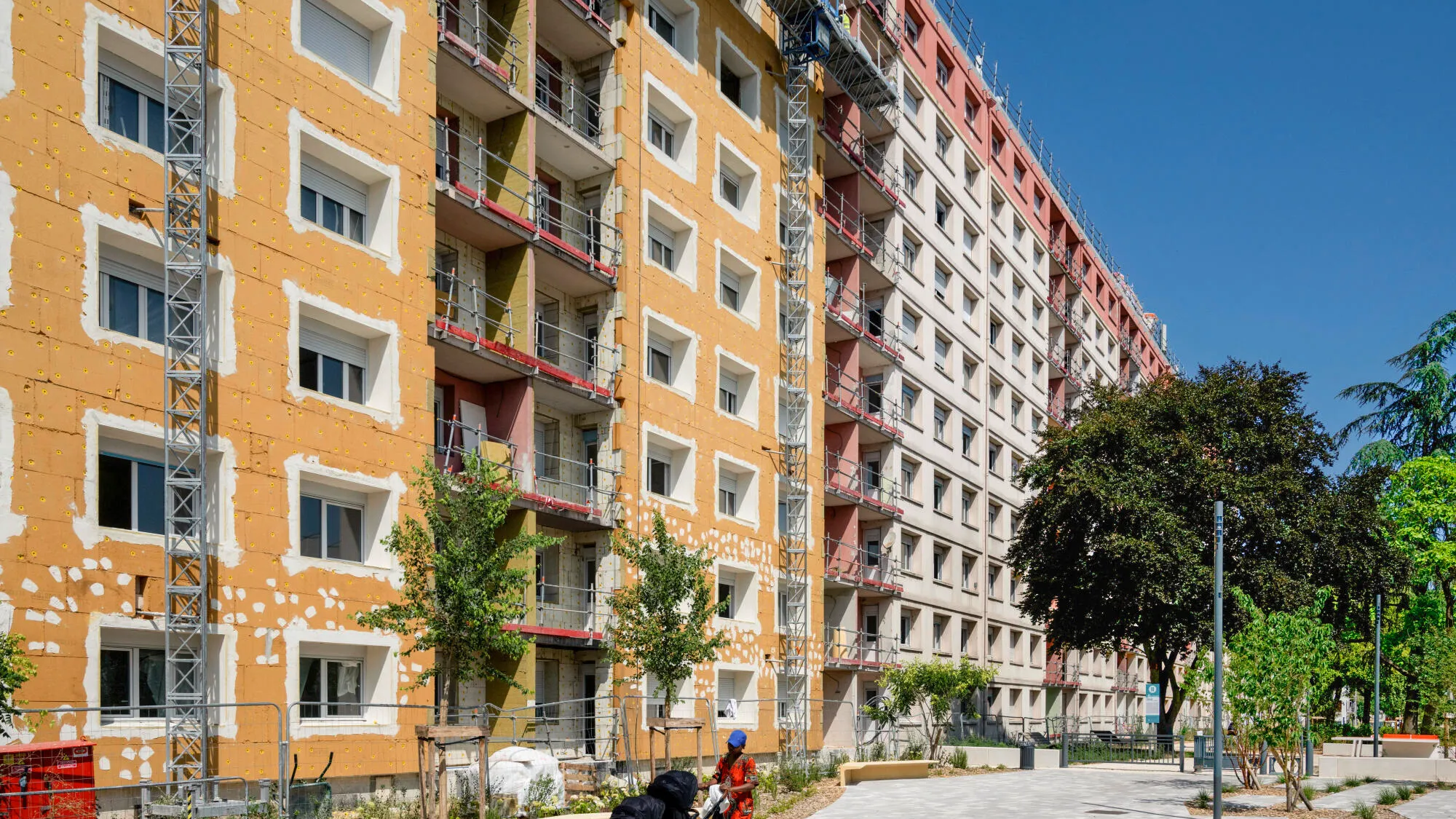
However, initiatives are emerging, such as the “Second Life” pilot project led by the social landlord Est Métropole Habitat in Villeurbanne. On this last day of June, engineer Paul Sachot shows the site of the Pranard residence: 343 housing units spread over five blocks of buildings built in the 1950s.
The strategy deployed here to prepare for the coming climate: exposing the concrete structure, laying 20 cm of wood wool (a biosourced insulation with high inertia), or even adding exterior passageways and shutters to block the sun’s rays (see photo above).
“A square meter of window that catches the sun is equivalent to a 500 W radiator that heats up,” he explains. The lessor hopes to move from an energy label F to B and is aiming for the Low Energy Renovation Building label. This major renovation costs 120,000 euros per accommodation, compared to 75,000 euros for a standard renovation.
It took three years of regulatory battle led by the Social Housing Union for the State to agree to favor this work rather than demolition, via tax measures only applied since 2025. Delivery scheduled for September 2027.
Air insulation and treatment
In the city center of the same town, at the Léon-Jouhaux school, it’s the lunch break. Just before going on vacation, the students play in the playground and their teachers have lunch in the teacher’s room. This building from the 1950s was a real “thermal sieve”.
Its renovation was based on exterior insulation and a high-performance air handling unit. Installed in the basement, it blows air cooled by 10°C compared to the outside after passing through a filter soaked in water.
According to readings carried out on June 26 by the city, neighboring schools were close to 36°C, while this one was only at 27°C. However, a teacher says: “It’s a shame to have spent so much money so that we’re still so hot!” » His remark highlights an unexpected obstacle: uses. The system is only effective if the windows remain closed and the blinds lowered, reflexes that are difficult to establish when faced with the habit of opening to “get some fresh air”.
Municipal technician responsible for energy management, Frédéric Seuté recognizes that awareness is necessary, especially since users often expect “an air conditioning effect”. “Such an operation costs 6 million euros per school. Villeurbanne has 27! », alarms Jacques Vince, the deputy mayor in charge of municipal heritage.
On this basis, the city will only be able to renovate a handful of establishments per mandate… unless it decides nationally on a “Marshall plan” for adaptation. Because in the Lyon region as elsewhere, each degree gained indoors is a victory over summers which no longer forgive the mistakes of the past.
* Source: Climadiag from Météo France.


