“The mystery of Stonehenge grabbed me”
Dear fellow citizen – because you have just obtained French nationality! –, why did you want to be welcomed among the “grumbling and arrogant” French people, as we are often considered abroad?
Grumpy and arrogant? No more than us! I love France, the French people and your way of life. You eat well, drink well, are elegantly dressed, talk about exciting, intellectual, political or artistic things… In the United States, for example, it’s impossible: you can only talk about sport!
I lived for several years on the Côte d’Azur. We even bought a house there, my wife and I, but we only came there very little because the presence of my wife, who was a Labor MP, was required in London. After Brexit – a disaster – I applied to become French.
How is the UK doing?
Very bad. Since leaving the European Union six years ago, it has been even worse than feared. The ruling Labor Party would like to make reforms in the areas of health or education, but the coffers are empty.
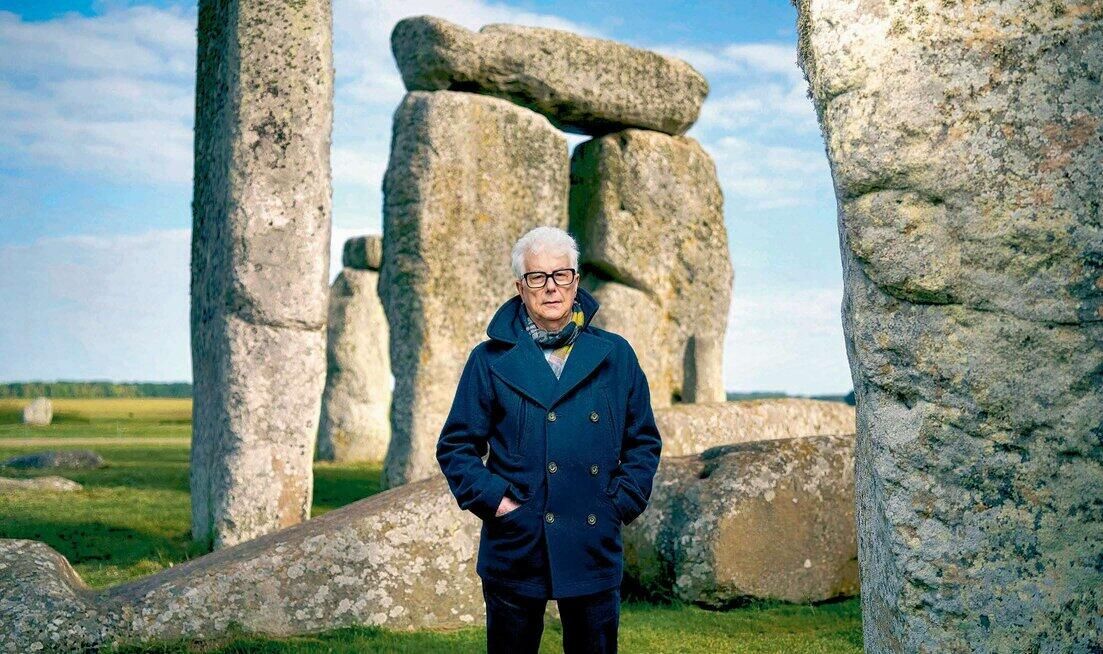
In The circle of days, you go back very far into the past of your native land, to prehistory. What attracted you to Stonehenge?
The mystery. We know almost nothing about the time when these stones were erected, between the second and third millennia BC. The writing, which was already used by the Sumerians in the Middle East, was not yet known in the West. We therefore only have traces, remains, which can be found on or in the ground: tools, cut flint, tombs and… standing stones. No metal, because the people who lived there did not know it.
How were people able to erect rock monuments that could reach up to 8 meters in height and weigh 25 tons, without having either the metal or the wheel and without using animal teams either? After conducting the experiment, scientists concluded that it took about two hundred men to move such stones. They had to use systems of ropes and logs of wood. To accomplish this feat, they also undoubtedly needed a charismatic leader, like the priestess Joia in my novel.
And why these circles of megaliths? You make it a calendar, a place of worship, a burial, but also a market place and celebrations. Is it plausible that this was so?
Yes. Studies on the first civilizations show that religion, science, celebration and commerce were mixed. The study of the sky began very early in order to navigate and count time: it was the beginning of science, always associated with priests and priestesses. They controlled the calendar of festivals (winter and summer solstices). These skills are found in the ancient Mesopotamian and Egyptian civilizations.
In your novel, you invent four human groups, each of which has its own way of life. Imagination or reality?
The Salisbury Plain*, on which the Stonehenge site is located, is bordered by three rivers. We can think that part of it was used as pasture by the breeders, another by the farmers, while the hunter-gatherers were more in the forest. It is a form of division that we still see in tribes or peoples in Latin America or Africa. But these are of course only hypotheses. On the other hand, we are certain that miners and stonecutters were settled here, because mines have been found not far away.
You also place women at the center of social interactions. It was the priestess Joia who launched the construction project. Now, these societies were rather patriarchal, right?
This is what was assumed and written. But we may have been wrong… Historians like Jean Gimpel, author of Builders of cathedrals, studied the tax statements paid by workers on the Notre-Dame de Paris construction site. And we realized that many women had participated. Mortar and glass manufacturers… 17% of the workers were female workers! Why wouldn’t it be the same for other monuments?
I wanted to give a little more space to women. But the other main character of the book is a man, Seft, a flint knapper, an ingenious engineer who creates fabulous machines. What interests me is when ordinary people do extraordinary things!
You choose heroes from each community and we follow them throughout the novel, fearing for their lives…
Unfortunately, there is no shortage of conflicts. Archaeologists have discovered deposits of a thousand flint points on the Stonehenge site! We also find skeletons whose bones have been fractured or pierced by weapons… We can assume that the desire for territories or livestock but also romantic conflicts were at the origin of these attacks.
In my novel, farmers seize land from breeders, requisitioning the banks of the river. And when the drought arrives and the animals want to get closer to water at all costs, then serious problems begin…
Breeders, men and women of the woods, priestesses… All have unbridled morals, except the farmers. Was this sexual liberality prevalent at the time?
That’s what I assume! The Ancients (the Greeks, the Romans, etc.) seem to me to have been freer in this regard. But I don’t know anything about it. If the farmers have a more conservative culture in my novel, it is because of their sense of ownership, which applies first to the land, but can extend to their companions. In many civilizations – ancient and current – women are the property of fathers, then of husbands.
Conversely, we can imagine that breeders letting their animals graze together freely – because there is no iron to mark the herds – have less of a sense of ownership. Their women are thus freer to marry whoever they want or to express their opinions. This is my feminist side coming out.
* Chalk plateau of 780 km².